
This summer, Hollywood launches an adaptation of Homer’s Odyssey … and yes, I have opinions.
I saw critics weighing in on the casting choices, some of them racist, which I disagree with. Personally, I think Lupita Nyong’o is a welcome disruption of the Aryan way Hollywood has long portrayed Helen. The world’s most beautiful woman came from a world centered around the Mediterranean Sea, not the Nordic or Baltic one. As someone with a secondary school major in Ancient Greek, who spent her teenage years translating and analyzing fragments of the Odyssey, and who devoured Madeline Miller’s Circe in one sitting, I have a few things to say.
But I’m not here to talk about the casting. I’m here to talk about Penelope.
“The Faithful Wife” — and Why That Reading Drives Me Mad
In most retellings, including Christopher Nolan’s newest adaptation (has he ever put a woman at number one on the call sheet?), Penelope is framed as the ideal wife: patient, faithful, enduring. She is defined in contrast to Clytemnestra, Agamemnon’s wife who murdered her husband, or Helen of Troy, who blew up the whole world for love. Penelope is the good one. The one who waited.
I want to offer you a different Penelope.
Penelope Featherington, I mean Penelope of Ithaca, was a bloody smart trickster. And I would argue she was a bigger one than Odysseus himself.

The Trickster at Her Loom
When Odysseus fails to return from the ten-year Trojan War, 108 suitors descend on her household, each angling for her hand … and for control of Ithaca. Penelope has no army, no champion, and a son, Telemachus, who is still too young and too naïve to fend them off. She is surrounded.
So she does what tricksters do: she buys time with misdirection.
She tells the suitors she cannot remarry until she has finished weaving a funeral shroud for Laertes, Odysseus’ elderly father. By day, she weaves. By night, she secretly undoes her work. She keeps this up for three years. Three years of looking industrious and grief-stricken, while actually doing nothing but stall.
Then there are the Twelve Maids. According to some versions of the myth, Penelope deliberately placed these women among the suitors to spy on them, gathering information, managing the household’s internal politics, staying one step ahead. The maids were later executed for their perceived disloyalty. The Odyssey presents this as Odysseus’ justice. But who put them there in the first place?
And if you want to go deeper into the mythological weeds: in some alternative traditions, Penelope slept with the suitors and gave birth to Pan. Whether or not you believe it, the fact that the story exists at all tells you something about how ancient audiences understood her, not as a passive waiter, but as a woman with desires, agency, and complexity.

Penelope, you can meet her in every time period
Some months ago, I heard a delicious story about Dolly Parton … that … apparently… she cultivated her bombshell image precisely because it made men underestimate her. While they were busy not taking her seriously, she was quietly building one of the most powerful entertainment empires in American history. She let them believe what they wanted to believe. Sound familiar?
The Living olive tree
When Odysseus finally returns, Penelope does not simply believe him. She is too smart for that. She knows what gods are capable of … she has heard the story of Alcmene, who was deceived by Zeus disguised as her husband. So Penelope tests him.
She orders her slave Eurycleia to move the bed from their bridal chamber. It’s a trap: Odysseus built that bed himself, with one leg carved from a living olive tree still rooted in the earth. It cannot be moved. Only her real husband would know that.
He protests, and she knows.
I keep thinking about what a retelling of that moment might look like from the olive tree’s perspective. Rooted in one place for decades, growing slowly, watching everything … and suddenly becoming the hinge on which an entire homecoming turns.

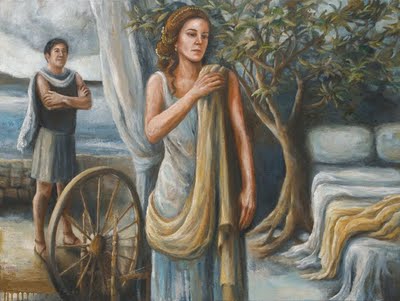
Another tree flashback: Odysseus clinging to a fig tree
At some point, Odysseus clings to a fig tree to survive Charybdis. Knowing that fig trees in the Mediterranean were associated with female fertility and cunning, and they have this quality of hiding their fruit inside, you wonder if this fig tree was not a metaphor for Penelope.
Margaret Atwood and the Danger of a Single Story
In 2005, Margaret Atwood published The Penelopiad, a retelling of the Odyssey from Penelope’s point of view, narrated from the underworld, with the Twelve Maids as a Greek chorus who have not forgiven anyone for what happened to them.
Atwood does not call the book feminist. I disagree with her. Or rather, I think she’s being coy. The book is fundamentally about whose perspective counts, whose suffering gets named, and who gets to tell the story. That is as political as it gets.
The Nigerian writer Chimamanda Ngozi Adichie has a famous TED talk about the danger of the single story, the idea that when we only ever hear one version of a person, a culture, a myth, we flatten them. The Odyssey has given us a single story about Penelope for three thousand years. Atwood cracks it open. She gives us the maids’ fury. She gives us Penelope’s ambivalence, her loneliness, her dry wit. She gives us a woman who is not simply loyal, but calculating … and who knows the difference.
If you want to dig into the theatrical side of this, the CBC has some excellent videos of Atwood’s stage adaptation here.

What Homer Knew (and What Nolan May Have Missed – But I Will Figure Out in a Few Weeks)
It has been twenty years since I co-translated fragments of the Odyssey from Ancient Greek into Dutch. One thing that has stayed with me is how Homer, whoever Homer really was (and I’d encourage you to read scholar Sophie Strand on why that question matters), gives Penelope real interiority. She is ambivalent. She asks Artemis to kill her. She appears before the suitors when Athena nudges her to, and the text does not pretend this is purely strategic. Scholar Irene de Jong writes that Athena wants Penelope to appear before the suitors “that she might set their hearts a-flutter,” while Penelope herself has no clear motive, “she simply feels an unprecedented impulse to meet the men she so loathes.”
That gap between divine motivation and human feeling is where Penelope lives. She is not a symbol of fidelity. She is a woman doing something extremely hard, for reasons even she does not fully understand.


The archery contest at the end of the Odyssey, the one where only Odysseus can string his own bow, is often read as his triumph. But Penelope is the one who proposed it. She is the one who controlled the terms. Greek scholars call the deep understanding between Odysseus and Penelope homophrosýnē (ὁμοφροσύνη) — “like-mindedness.” They are equals. They are both tricksters.
She just had to be cleverer, because she was the one left holding everything together. Odysseus gets all the credit for cunning. He has an epithet for it: polytropos, the man of many turns. But Penelope held a household, fended off 108 suitors, and kept an entire kingdom together for twenty years using nothing but her loom and her wits.
Handwork, Water, and Goddesses
Penelope’s mother was a Naiad, a water nymph. In Atwood’s retelling, her mother’s only advice was to be like water when you meet an obstacle: move around it, not against it. That image has always struck me as the key to Penelope’s character. She doesn’t fight the suitors directly. She flows around them, wearing them down, biding her time.
Her weaving, too, is more than a plot device. In the ancient world, textile work was ritual, mathematical, and sacred. The loom was a technology of patience and precision. Penelope weaves and unweaves, creation and destruction held in the same pair of hands. There is something quietly radical about that.
A Retelling Still to Come
I have not written a retelling of Penelope yet. But I think about her often, especially alongside what I know from my own work on Baltic mythology. Cunning women who let people believe what they want to believe. Women who spin stories the way they spin thread: not to deceive for its own sake, but to survive, to protect, to buy one more day.
Whatever version of Penelope’s story is “true”, and there are dozens of contradictory myths, what storytelling research consistently shows us is that multiple versions, multiple perspectives, are not a problem to be solved. They are the point. Every retelling reveals something new about who the teller is, and what they needed the story to do.
Somewhere in Ithaca, there is a bed with one leg carved from a living olive tree, still rooted in the earth. It has been there for three thousand years. It watched Odysseus build it, watched Penelope use it as a trap, watched a marriage prove itself in the one thing that could not be moved or faked. A tree that old has heard every version of the story. It knows which ones are true. It isn’t telling.
I’m working on a pocket book with a retelling of Penelope, from the olive tree’s perspective. If you want to know when it’s ready, subscribe to this website.
References
- Homer. The Odyssey.
- Atwood, M. (2005). The Penelopiad. Canongate. Miller, M. (2018). Circe. Bloomsbury.
- CBC Books (2017). The Penelopiad — stage adaptation. https://www.cbc.ca/books/the-penelopiad-1.4005595
- de Jong, I. (2001). A Narratological Commentary on the Odyssey. Cambridge University Press.
- Strand, S. (2021). The Flowering Wand: Rewilding the Sacred Masculine. Inner Traditions. (on Homer and oral tradition)
- Adichie, C.N. (2009). The danger of a single story. TED Talk. https://www.ted.com/talks/chimamanda_ngozi_adichie_the_danger_of_a_single_story
- Wikipedia entries, such as Penelope: https://en.wikipedia.org/wiki/PenelopeAlcmene: https://en.wikipedia.org/wiki/Alcmene The Penelopiad: https://en.wikipedia.org/wiki/The_Penelopiad
Discover more from Stories from the Wood Wide Web
Subscribe to get the latest posts sent to your email.