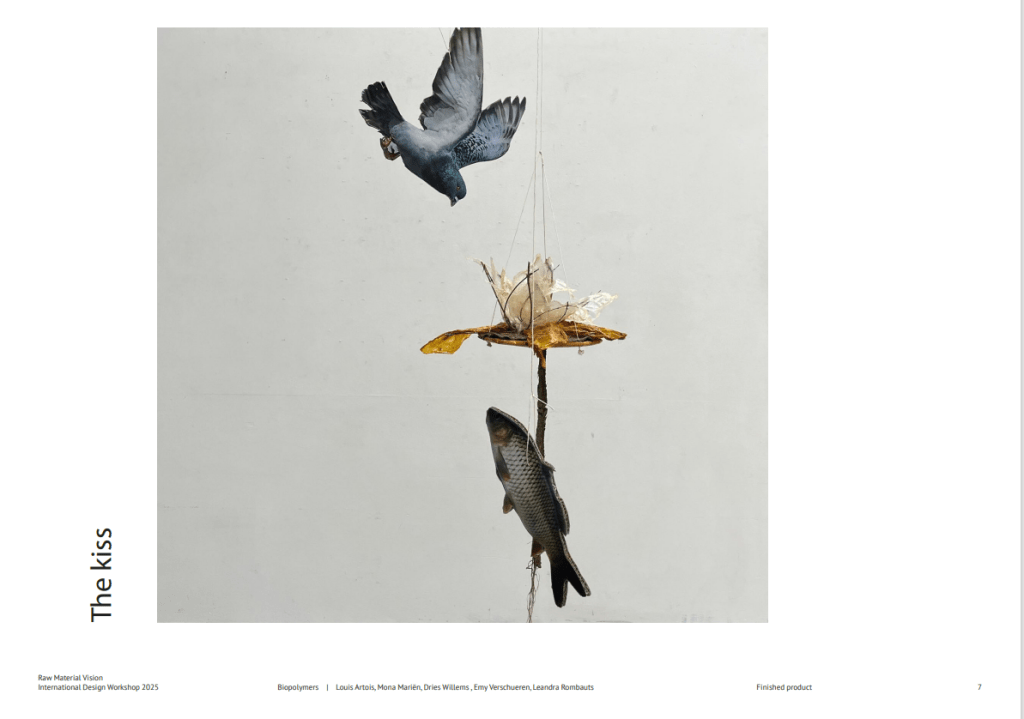
The 3D object and the science fiction prototype are created by students Leandra Rombauts, Emy Verschueren, Louis Artois, Mona Mariën and Dries Willems. This workshop in Antwerp was co-funded by the RAW project (European Innovation Council).
One of my main activities and skills is workshop facilitation. I have facilitated more than 110 workshops and circles, often in collaborations with other professionals. I create spaces where deep listening is central, and in different formats:
🕸️ Live and offline, from a few hours to multiple days
🕸️ in Europe and Asia
🕸️ multicultural groups
🕸️ outdoor spaces (e.g. forest baths)
In February 2025, I got selected to co-facilitate a five day long workshop in Antwerp, my birth town. And I had so much fun to design a workshop, where I combined forest bathing, science fiction prototyping, hydrofeminist frameworks and lowtech material experimentation. I was even more pleased (but not surprised) when one of the five student teams made an… ecomythology.
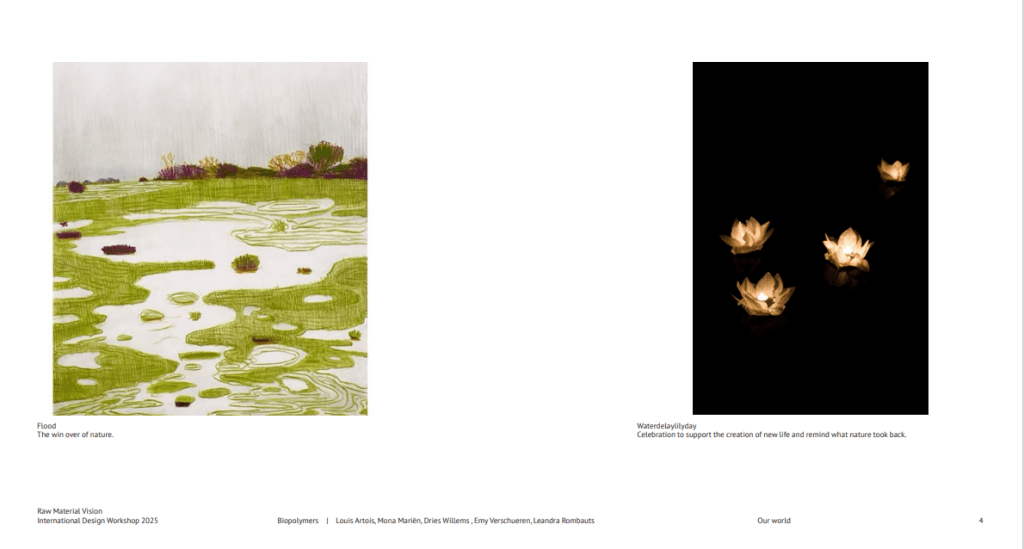
What is ecomythology?
An answer to all eco-anxiety. The organisers of this workshop week asked to facilitate the creation of whimsical futures, not sad dystopian futures. In my interpretations, that means the creation of hopeful stories, or Flemish ecomythologies.
A subsection in a blog is not enough and I would like to send you in a big rabbit hole, with the help of two selected online texts:
- https://serpentedalua.com/eco-mythology-gathering-portugal-2023/
- https://sofiabatalha.medium.com/mystery-literacy-e840a97df8b8
If you are looking for a summer reading during your next Portugal trip, I recommend to get a copy of ‘The Sanctuary’ by Sofia Batalha. In this collection of revived Portuguese eco-mythologies, Sofia invites us moderns to reconsider our relationship with the living and storied landscapes.
Facilitating workshops for whimsical biofutures and biomaterials
@idw_antwerp is the annual International Design Workshop week for master students of the Faculty of Design Sciences of the University of Antwerp, as well as for master students of the Royal Academy of Fine Arts of the AP University of Applied Sciences and Arts Antwerp.
The IDW week 2025 edition aims to explore WHIMSICALITY using the power of the critical design attitude. Instead of the traditional affirmative design approach (problem-solving and solution-focused), the aim of the IDW week is to focus on ‘problem-finding’. This critical design attitude leads to a deeper understanding of all factors that influence a design and encourages to reflect on the impact of a solution or intervention. It triggers the exploration of alternative and out-of-the-box scenarios thus increase the likelihood of more (socially) sustainable and desirable futures becoming reality.
In the “Raw Material Vision” workshop, that I co-facilitated with Esther Vandamme, 26 participants embarked on an immersive sensory journey exploring the potential of renewable materials such as #hemp, #reclaimedtimber, and #biopolymers. This blog foregrounds the team of students that selected biopolymers as their material track.
start touching, start experimenting
These biomaterials come with their challenges and limitations. Yes, each material has its strenghts, weaknesses, opportunities and threats (SWOT)… and that is ok. You embrace it, you do not avoid the weaknesses and threats. Of course you have to know the SWOT of the material.
In the RAW project, we address some of the challenges with digital technologies and a strong focus on stakeholder engagement. The RAW project is ambitious by exploring opportunities for structural applications in construction.
During this workshop in Antwerp, it is all about lowtech material experimentation and exploring futures. Less about – for example – comparing non-destructive assessment methods for structural use. More about touching, smelling, hearing, … perhaps tasting (?).
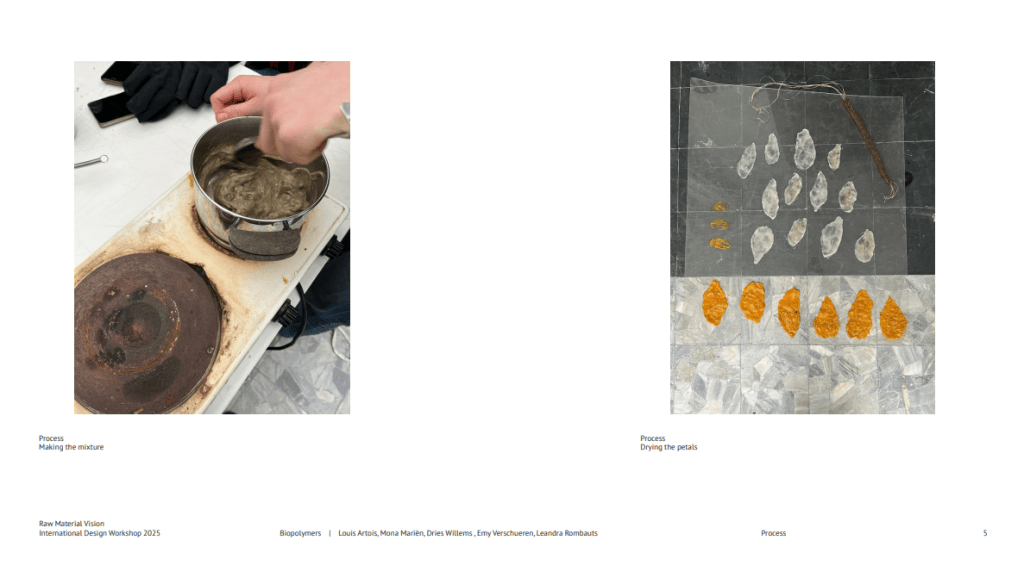
Crafting biopolymers is as simple as following a cooking recipe
The biopolymer students got some basic ingredients of a recipe, but they were encouraged to add local ingredients. During one of the two site visits, the students sampled river water of het Schijn, a river in Antwerp. Het Schijn is one of the characters in my own upcoming academic essay on proposing a hydrofeminist view on architecture and structures (under minor review). I was happy to hear when the students worked with this river and included the river in the 3D object that they were expected to create by the end of the workshop … and in their science fiction prototype.
Just like in cooking, the right ingredients and process can create something extraordinary. Making biopolymers for construction can be like cooking. Sensors—both machine and human—(should) provide real-time feedback, just like tasting your dish and realizing it needs a pinch more salt. Adapt, adjust, create.
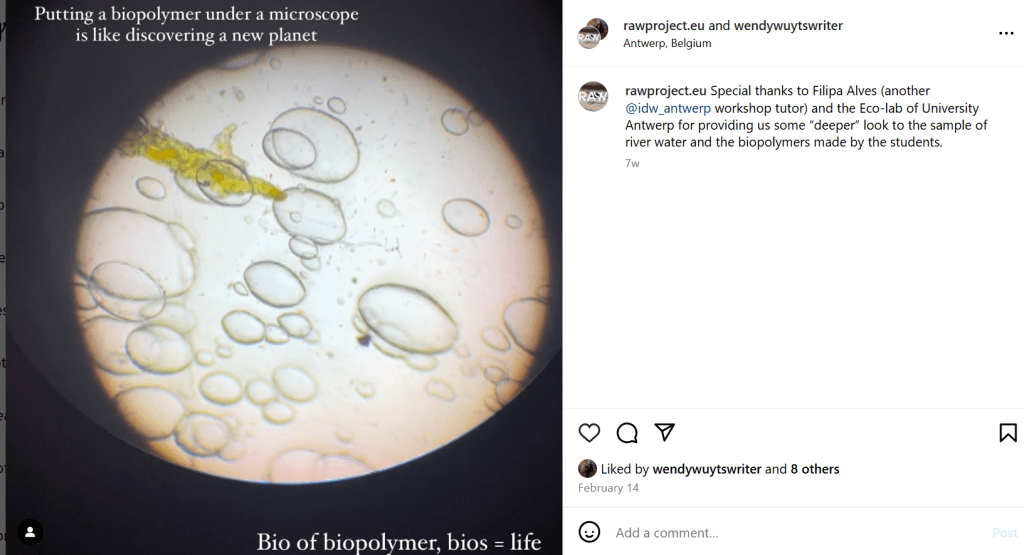
Some knowledge stays invisible… or not?
In that week, I got to know another workshop tutor who works with microscopes and introduced the students to her, so we could see the invisible level of entities that the students sampled and created. For me it was a reminder how much data and knowledge stays invisible, until we find the right instrument or story-holder or facilitator.
From science fiction prototype to an ecomythology
The boundary between mythology and science fiction is thin. Very thin. One module of the five-day long studio was science fiction prototyping (SFP. The core methodology is the use of creative arts as a means to introduce innovations into science, engineering, business and socio-political systems. Every day I guided the students through a process. The first step according the pioneering futurist is to pick Your Science and Build Your World. However, my second step is different than the main handbook, as I want a feminist-informed SFP. That is why I propose to add a character. I give them a selection of human and nonhuman characters. Four of the five student groups selected a nonhuman characters.
(Un)consciously, the facilitator influences…
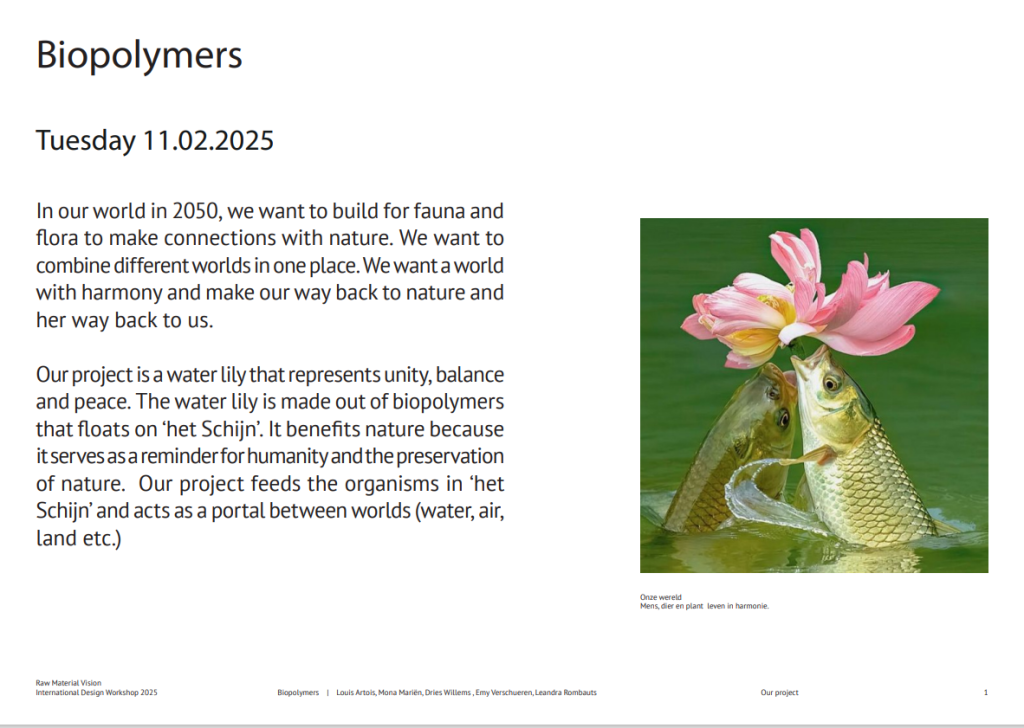
To my surprise, – already on the second day- the students proposed to make a water lily – with the biopolymers. Was that a coincidence? Do they know that I associate water lilies with feminism, thanks to this paper by Gagliano and Gibson, a paper that I often cite during the Writing (with) plants sessions. I tried to remember if I had influenced them, if I had mentioned this paper in one of my short talks, but I did not recall that I had talked so much about plants and feminism (yet).
Of course, when I look back, I notice many influences in the science fiction prototype and the 3D object. I selected the site, the characters, some of the references… As a facilitator you are never separated from the participants, and what they create. As a facilitator you boost the collective intelligence. As a facilitator, you are the chef cook.
Perhaps the chef cook did never touch every dish that leaves the kitchen. Perhaps the chef cook did provide only the frame, the kitchen, the appliances. Perhaps the chef added a bit of salt here, and a bit of cinnamon there. But the influence of the chef cook is present in the experience.
The science fiction prototype of the students
They had to deliver every day 100 new words. By the fifth day, they had to provide a science fiction prototype of 400 words, ready to be exposed in an exhibition to other humans. According to some handbooks, the SFP should be 6-12 pages. However, I made a recording of 20-30 minutes during the exhibition where another expert and I asked questions to each student team. The recordings will be transcribed and part of the analysis.
What I like about the word prototype is that it means that the story is not finished. I have been working years on the stories that got published, especially Tussenland. I am aware that the science fiction prototypes will not grow into full science fiction stories, but they will keep influencing – on their turn- the research agenda and design in the bigger RAW project.
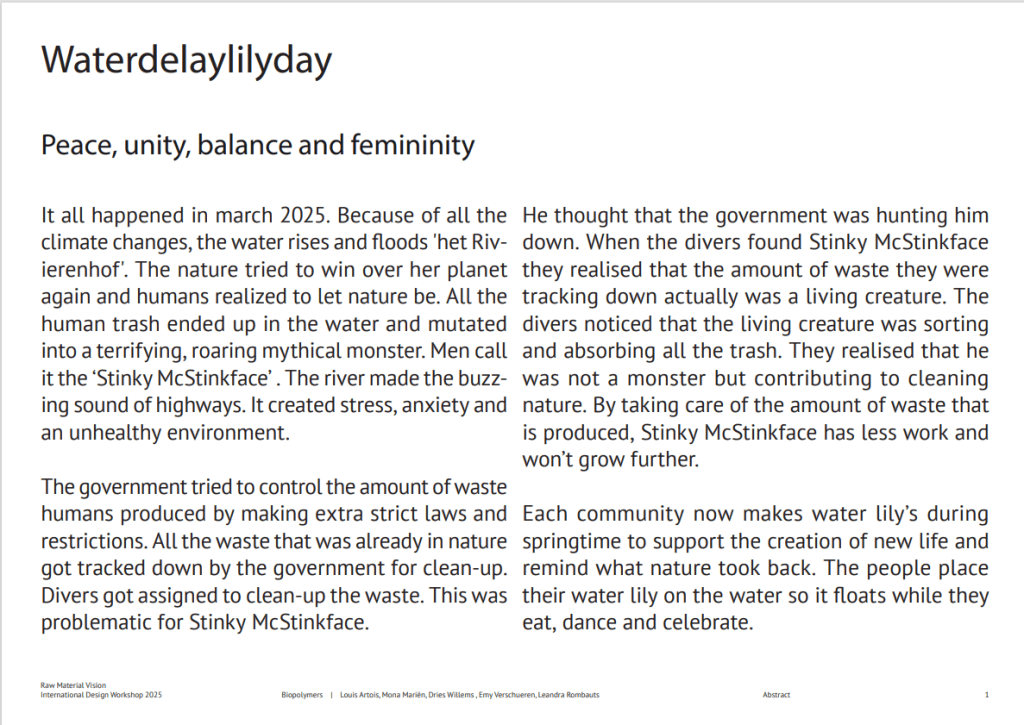
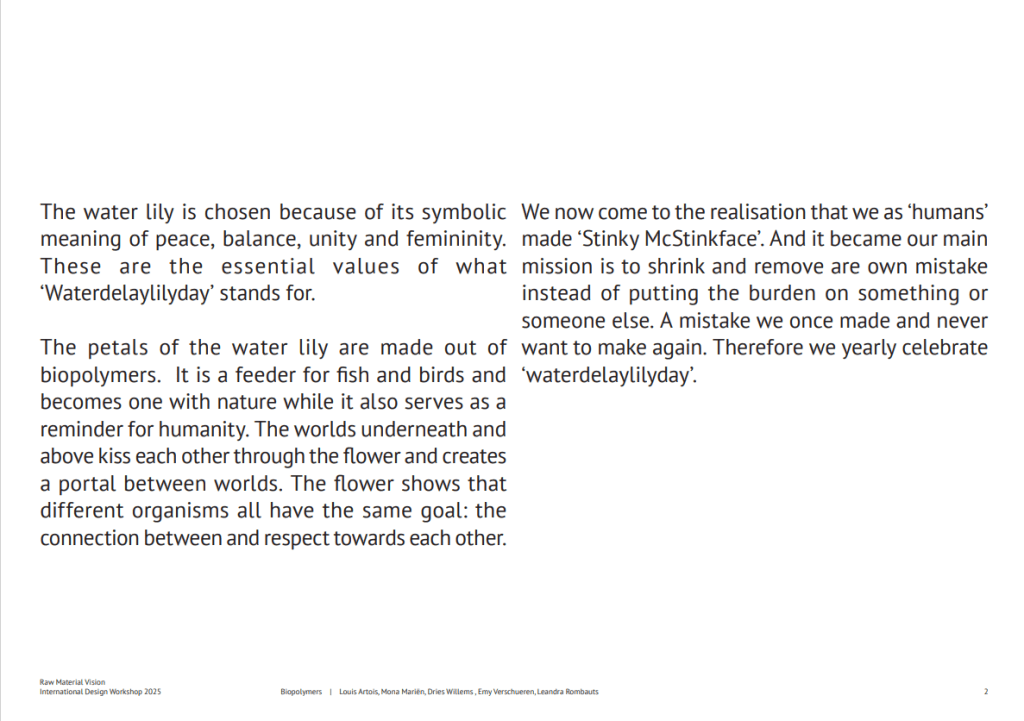
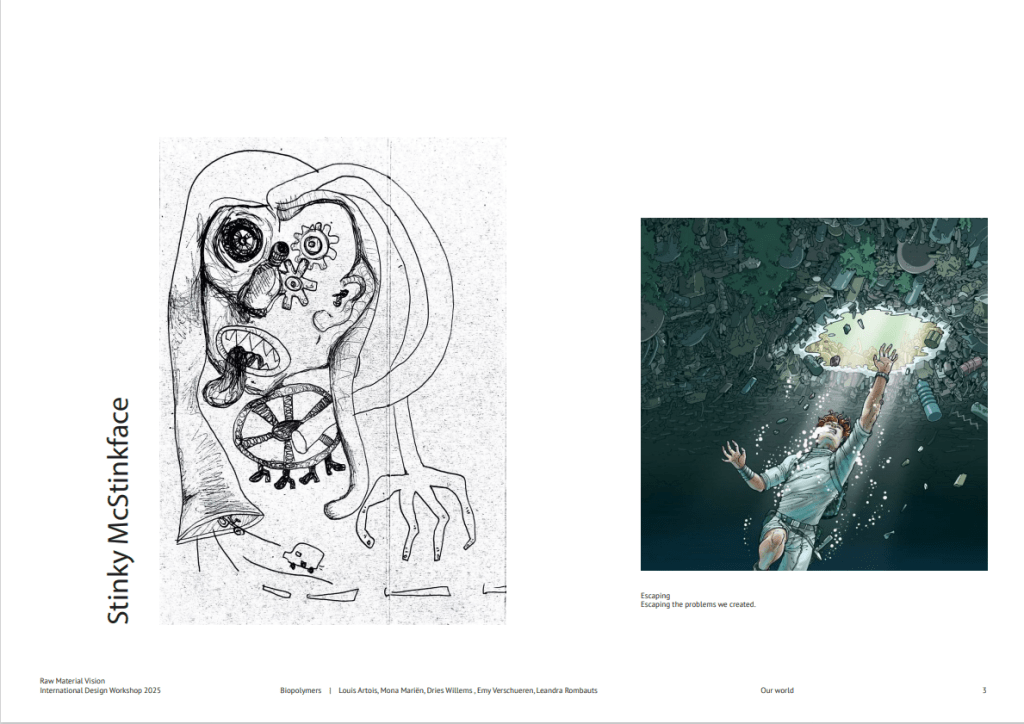

During the Towards Integrative Design symposium in Innsbruck, Austria (22-23 May 2025), organised by the department of Integrative/s Design | Extremes and the Bio-Futures for Transplanetary Habitats initiative at the University of Innsbruck, the abstract that I wrote with my co-facilitator about the practice (combining forest bathing, feminist-informed science fiction prototyping and low-tech material experimentation) got selected for an oral presentation. More updates connected with the RAW project will follow in the coming months.
Contact me if you are interested in an (eco)feminist-informed science fiction prototyping workshop for your team. From February 2026 onwards, my calendar is less full-booked. Hence, I am open for collaborations from spring 2026 onwards.
Discover more from Stories from the Wood Wide Web
Subscribe to get the latest posts sent to your email.
 Stories from the Wood Wide Web