“I stared out at the swamp, the master cook of nature and the grave of many. I could feel the wounds of the swamp, like I felt my bruises. The swamp and I were full of so many stories—minerals, fungi, rot, bacteria, and ashes of our ancestors. We were all in this together.“

Ecozon@ published another short story. This short story is set in the same world as my fiction books (only in Dutch, De witte droom and De rode regen) and two other short stories (An Apple Tree in Daegu; A Linden Tree in Tongerlo). The short story is part of an issue on Disruptive Encounters. Concepts of Care and Contamination out of Control.
My artist statement
The short story features Sámi characters and practices. However, it is not mentioned explicitly that they are Sámi. In summer 2020, Wendy moved to Norway. But already before, she did not learn only about Norwegian culture, but also tried to inform herself about Sámi practices through folklore books and articles (some recommended by Sámi), visits to their lands, and talks and homestays (not in touristic sense) with Sámi and Norwegians who have Sámi family members and have maybe Sámi blood themselves. In the 19th-20th century, policies discriminated against the Sámi and their practices, which led to erasure of knowledge and stories. She felt that it would be unethical to feature only Norwegian people in a nearby future and erase Sámi in the land that inspired this story on loss and wounded/contaminated/damaged landscapes and healers.
In this video reel on Instagram, I explained the uncomfortable feeling of featuring indigenous people and practices while not being indigenous myself.
Comment from the creative writing and arts director of the journal:
Elizabeth Tavella, University of Chicago, USA:
“Closing the Arts section is Wendy Wuyts’ short story “An Ash Tree in Os” envisioning with speculative undertones a future of harmonious coexistence between Norwegian Sámi and non-Indigenous individuals. Yet, this is not a lighthearted look at the future. It is a story of loss and grief, of ecoterrorist attacks, pandemics, and (androcide).
At the same time, it is also about reparations and healing, of collaboration and hope, of connection with the landscape and communion with the more-than-human (“I myself had come to the conclusion that if the landscape was so polluted that I must also be polluted”; “We are all made of bacteria, constantly in exchange with the more-than-human world”).
Throughout this process of renewal and rebuilding, during which contamination goes hand in hand with regeneration, the land does not forget: “The swamp and I were full of so many stories – minerals, fungi, rot, bacteria, and ashes of our ancestors.”
In all this, the Ash Tree stands strong, a keeper of intergenerational wisdom, entangled and prospering and suffering together with the whole community, which would gather under the tree to share “where new rhubarb was spotted. When the first mushrooms and berries emerged. A story about a sickness for reindeers. A song for healing broken fingers.”
Ultimately, then, it is the power of multispecies storytelling that enables the possibility to re-imagine and practice interspecies conviviality as a “matter of care” (Puig de la Bellacasa 2017) as well as “cultures of gratitude” (Kimmerer 115) that nurture the formation of new alliances built on principles of mutual aid and reciprocal trust.
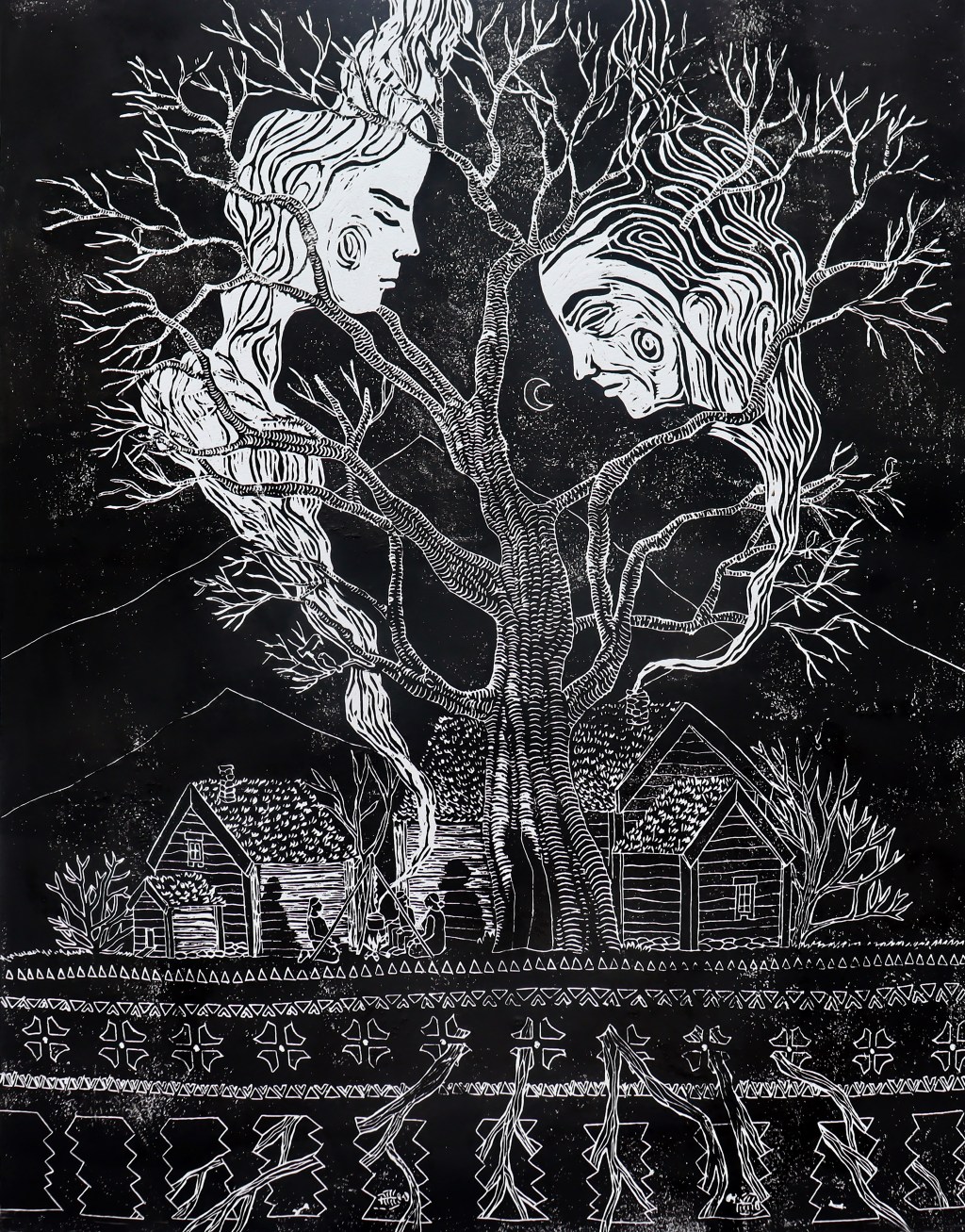
The hand carved woodblock print by artist Laura Brusselaers sublimely evokes the atmosphere of the text: the campfire gathering, the smoke shapeshifting into two human faces looking inward, the soil featuring a rich tapestry of Sami culture, with the roots of the Ash tree growing through it and the bones of the ancestors resting beneath them, all contribute to building a wondrous visual representation of intergenerational and interspecies entanglements”
Comment by the main editor:
Heather I. SullivanTrinity University, USA:
“Finally, the Arts section closes with Wendy Wuyts’ short story “An Ash Tree in Os,” illustrated with a marvelous wood cut by Laura Brusselaers, an Independent Artist from Belgium. The story does not explicitly state its focus, but the artist statement notes that it “features Sami characters and practices” experienced by Wuyts after she moved to Norway.
In the swamps of rot, death, and decomposition emerge life forms: this tale of grief, illness, and feminicide brings us into terrible encounters tainted still by the hope for the possibility of ongoing entanglements with the plants and beings rising out of the murky waters. Ending with fungi, our clever connectors who link trees and plants throughout entire forests and grasslands who thus may well be our most important ecological enablers, Wuyts leaves us with a poetic image of the life of death and the underground and the underappreciated beings whom we daily overlook and yet whom we will encounter again, and again.”
Visit the portfolio of Laura Brusselaers: https://forest-edge-atelier.com/
Follow Laura’s Instagram profile: https://www.instagram.com/forest.edge.atelier/
To read the full editorial: https://ecozona.eu/article/view/5625/6061
To access (for free) the short story and illustration: https://ecozona.eu/article/view/5033/6068
Discover more from Stories from the Wood Wide Web
Subscribe to get the latest posts sent to your email.
 Stories from the Wood Wide Web