Explore my ecofeminist rewilding project. Another working title is Digging up local saints, witches and other healers.
I am born in Flanders, Belgium, which was one of the first industrialized regions in the world. In addition, as an effect of the Roman empire and the inquisition of the church a lot of old (ecological) wisdom got erased, but other knowledge got buried under layers of nothingness. I like this metaphor that local wisdom is like an underground mycelium that still survives even if it is buried under many layers, or the mushrooms are plucked away. The traces of this underground consciousness/intelligence are still there. And when you find some traces, you can start digging to the core. Inspired by ecopsychologists and feminists, who use writing as a method, like Sharon Blackie, Clarissa Pinkola Estes and Doireann Ní Ghríofa, I look into archives and interpretations and do reimagination.
To find these traces, I engage often with other interpretations of stories of other cultures and look for associations and patterns. To avoid ethnofuturism, I try not to focus too much on one species but on relationships, and perhaps on purpose I like to refer to other cultures where similar patterns and wisdoms exist.
This project is not connected with any academic project. As a teen I learned to be critical about history and interpretations by scholars. In these blogs I can be totally wrong and I like to hear also your interpretations. Noteworthy, I make it myself more difficult by looking for especially female stories. Many female texts are erased and not well documented as male texts. This requires even more (re)imagination and (re)interpretation.
BLOGS EXPLAINING THE WHY – THE BACKGROUND
From Celtic source cult and tree devotion to worship of local female saints in Flanders
From Celtic Source Cult and Tree Devotion to Worship of Local Female Saints in Flanders Introduction:The woven tapestry of Flanders’ history is a rich blend of myths, legends, and tales that often go unnoticed. My personal journey to uncover these threads led me to the age-old Celtic traditions and practices which placed significant emphasis on female landscapes and women. These stories, deeply rooted in the heart of Belgium, carry lessons that address our modern-day ecological, social, and psychological crises. The Celtic Worldview:Dive deep into the history of Flanders, and you’d find a land dominated by the Celtic worldview. The Celts…
Ecofeminism anno 2024: Painting easter eggs with water from local wells and colors from the local land
March is Women’s History Month, a time I’ve traditionally used to share reflections inspired by my ecofeminist perspective. This month, I contemplate learnings, unlearnings, actions, explorations, and future plans. Coinciding with Easter celebrations in Europe, I reminisce about my childhood egg hunts in kitchens and gardens. Although I don’t have children, if I would have children, I envision creating a grand weekend ritual with them, celebrating the earth’s fertility, eggs, and all that embodies femininity and nurture. The story is in our bones I spent over a week in San Francisco, where on my first day at Dog Eared Books,…
dIGGING AND REIMAGIniNG:
Amelberga, the river and the sturgeon’s lifecycle
In May 2021, my father found a good book from the 1980s: Roeck and Marquet (1980). “Belgian sagas and legends”. Illustrations by Henri Lievens. In the chapter “the virgins,” Dymphna came back, who has inspired me writing some short stories (e.g. A Linden Tree in Tongerlo). This book introduced how the romantic movement exaggerated about the Christianization in the 7th-8th centuries. No, they did not tear down temples or kill sacred trees. The process took many centuries. The mental models of “ordinary people” were not so easily changed. They were Celts. The Church’s stories of holiness did not square with…
Dimpna, a story about an uprooted Irish princess rerooting in Flanders, and a 6 centuries old method of care for the mental ill
On a July day, in 2021, I was in Geel, with a fellow offspring of a witch that did not get burned in the 17th century, to “dig up some bones”. That’s what we call our project to look for the sites of local ancient stories. Geel is a town in the Campine (Kempen) which is known for the pioneering de-institutionalized method of care for the mentally ill. This practice is based on the positive effects that placement in a host family gives the patient, most importantly access to family life that would otherwise have been denied. The legendary 7th-century…
Digging in the stones, trees, mud, wetlands and folklore surrounding the Belgian Black Madonna (de Zwarte Madam)
(Originally I planned this as an academic article, but I decided to rewrite it into a blog and share it publicly on this website; I refer to previous work by other researchers. I am exploring AI nowadays; I used Dall-E to create some images and I used ChatGPT for language improvement, but I feel not that good about it… however, is digging and becoming dirty … not also about exploring toxic soils that you want to study?) In the heart of our increasingly mechanized world lies a pulsating core of green consciousness, a holistic worldview that threads through the tapestry…
A Flemish ghost in the throat: Imagining who Cathelyne van den Bulcke was
One week earlier, I walked with S., a friend, in the Flemish town Lier, once a rich city with Game of Thrones intrigues. The city has installed a walking tour, with different stops and QR codes, to learn more about the witches that were burnt, and in particular Cathelyne, the last woman was burned as a witch in Lier. When we were at the first stop, the old market square, we were surrounded by a fair with bump cars and shooting, and by huge decorations and ads encouraging people to shop, and have fun, to consume. The presence is so…
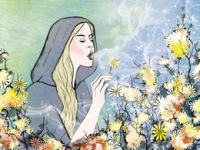
Cold Sophie, the Ice Saint, and the Cailleagh: Tracing the Divine Feminine Through Ice and Myth
One of my ongoing projects is exploring stories of the divine feminine in Europe, often hidden within the veils of local folklore, mythology, and the lives of saints. My journey takes me to the edges of Europe—Scandinavia, Ireland, the Baltics, and the Balkans—and to local female saints whose legends may have roots in pre-Christian goddesses. It’s a process guided as much by intuition as research. Two figures that have recently captivated my attention are Kalte Sophie (or “Cold Sophie”) and the Cailleagh, both connected to the season’s final frosts and the cycle of winter into spring. Their stories hint at…
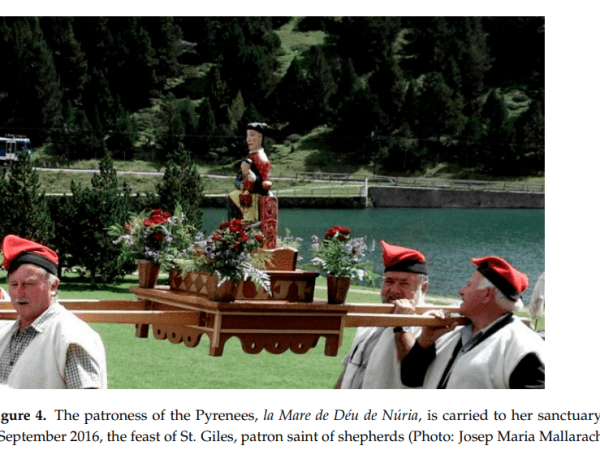
Sacred trees, Mystic Caves and Holy Wells in rural Spain – or to-visit-sites in your next Spain trip
Recently, I rediscovered a paper by Jaime Tatay, published in the journal Religion, while organizing my drive and considering the publication of a book about sacred trees based on a decade of research. The paper examines how local expressions of religion in Spain have creatively intertwined spiritual insights with popular devotions within ecologically significant settings, thereby contributing to the preservation of Spain’s rich biocultural heritage. It focuses on various Sacred Natural Sites (SNS), primarily Marian sanctuaries, and discusses how local “geopiety” and religious creativity have led to “devotional titles” linked to vegetation, geomorphological features, water, and celestial bodies. “baptised paganism”:…
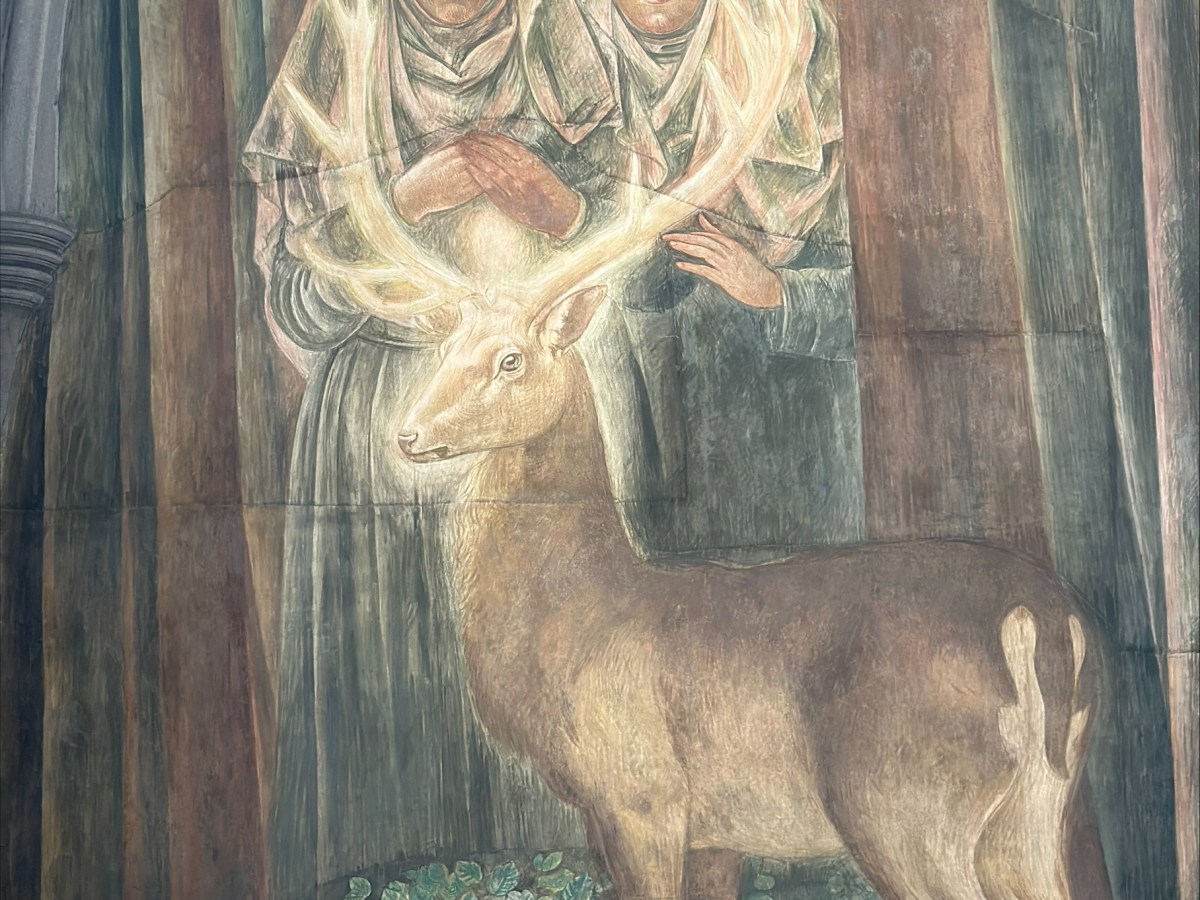
The Lost Ancient Forest of Zürich
Zürich is a city of deep, layered histories. As you walk down toward the Fraumünster church, you pass through Thermengasse, where remnants of a Roman thermal bath lie beneath your feet. There you’ll find traces of the Roman bathhouse and a plaque describing its Celtic origins. The Lindenhof, a peaceful hilltop park today, was once the Roman heart of Zürich—then called Turicum. Long before all of this, most of what is now Zürich was forest. It’s strange to remember that cities were once forests—both literally and figuratively. To be honest, I’ve never been in love with Swiss towns—only with Swiss…
This work has led to fiction (short) stories that have been published in Ecozon@, Uneven Earth and Educational Fabulations. The dream is to publish a book (mixed genre) in Flemish and English, with focus on this practice of re-rooting and rewilding Flemish stories that can empower women, men and others.
Do you want to learn more?
Sign up to a newsletter to receive blogposts and/or online workshops about Rewilding (female) saints. As you can see, a blogpost is written once a year, so this will be a very slow newsletter.
You can sign up via this link or by scanning this QR code:

 Stories from the Wood Wide Web