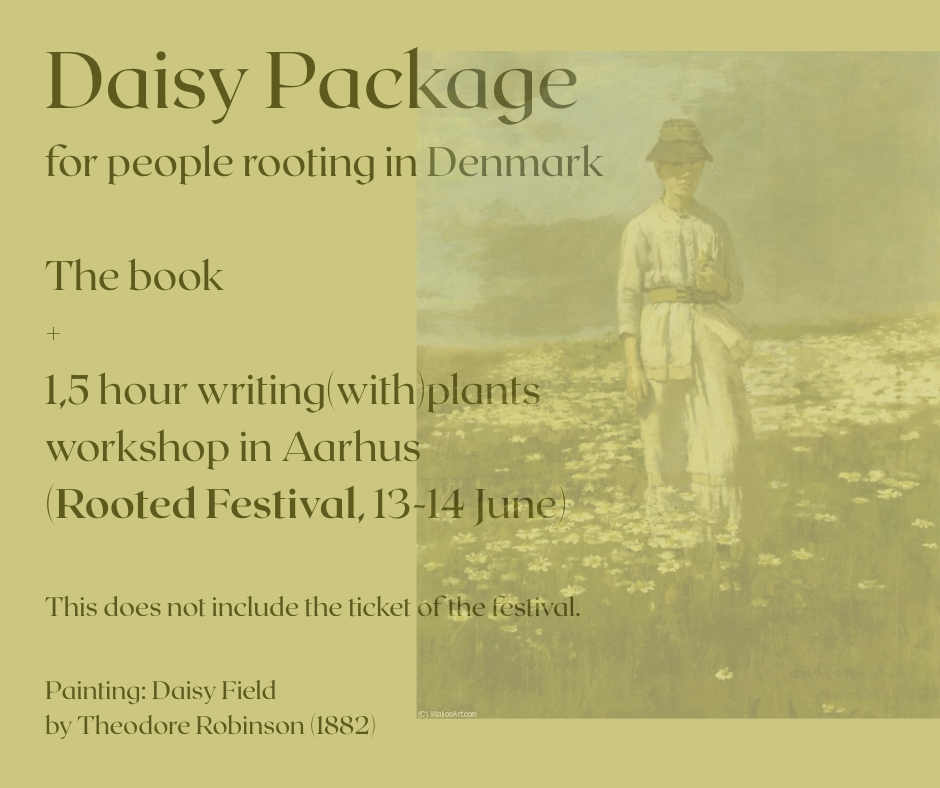
At the end of spring I will be again in Denmark. Let me share a bit more about the second edition of the Rooted Festival, where I am invited to host a writing(with)plants session. This blogpost is also connected to the crowdfunding campaign for the upcoming book. The Daisy package includes a book that I will personally give you in Aarhus during the festival.
Denmark… one of the most ‘cultivated’ countries in the world
Some months ago, at the end of the Ecomythology 1.0 winter symposium, we spoke about the need to work with narratives and models for enchanted personal journeys that are not necessarily grounded in experiences of remote, barely urbanised, industrialised, or cultivated places, like the Scottish or Irish coast. Many of us live instead in some of the most urbanised and cultivated regions, such as Denmark, the Netherlands, and Flanders.
Processes of magic and meaning-making require finding hopeful narratives within these landscapes. I think that, especially in what you might call ‘wounded landscapes’, one can find the most compelling stories. They are not stories about escaping the darkness, but stories that emerge from within it. In places like Denmark and the Low Countries, there is still a lot of more-than-human nature, but in small patches: tiny forests, small swamps, and many edges and hedges. Edges generate tensions, which can generate stories of conflict, and particularly of conflict resolution and care. Perhaps stories we need to hear more often?
Nostalgia instead of queer ecological joy
If you dig deeper, you find very old stories, not only from Viking mythology, but also from other Germanic cultures and earlier periods, which you can recalibrate… and perhaps new eco-myths can also be created in relation to current ecological systems, so that we do not rely too heavily on nostalgia.
More recently, I have been reflecting on how some television series (such as Stranger Things) trade on nostalgia, offering poor excuses to continue portraying toxic tropes from earlier periods, rather than speculating about alternative histories in which there is more queer ecological joy. But perhaps, instead of watching these series, which keep us somewhat confined, encouraging the idea that the past was better, it is preferable to go outside, to organise or take part in festivals, rituals, ceremonies, and events centred on connection: perhaps mourning, making art, and creating beauty.
The Rooted Festival, now in its second edition this June, is one such example. I will be offering another writing-with-plants workshop there. Tickets are available in tiered pricing, and I would be very happy to meet you there.
About the Rooted Festival in Aarhus
ROOTED is an interdisciplinary festival in Aarhus (Denmark) that brings together plants, people, and art.
Through performances, workshops, and rituals, we explore the role of arts in times of social and ecological crises. We explore how artistic practice can deepen our relationship with the living world. We reconnect with plants as medicine, wisdom-keepers, and allies in dreaming more liveable futures for all into being.
Next edition: 13 & 14 June, 2026.
Some extra info / useful links:
https://www.rootedfestival.com
https://www.lienejurgelane.com/rooted
https://www.facebook.com/events/2211290252734009
Writing(with)plants about Homecoming in Times of Ecological Excile
At the Rooted Festival, I will give a workshop with the tentative title: Writing (with) Plants about Homecoming in Times of Ecological Exile. This workshop invites participants into a gentle meeting place between forest therapy, creative writing, and ecological listening. Rather than writing about plants, we experiment with writing with them, exploring what it means to feel at home in an era of ecological disruption, migration, and polycrisis. Through guided meditation, collective knowledge-sharing around a local “guest plant,” and quiet sit-spot writing, participants engage plants as co-creators and companions in storytelling. Drawing from my own experiences across landscapes and my work with plant–human narratives, we reflect on belonging without ownership, connection without extraction, and the subtle wisdom plants offer through adaptation and resilience. The workshop closes with a sharing circle and an invitation to contribute to this website.
I also hope to use the new book of the writing(with)plant that you can pre-order until April 17th. It is a limited edition (200 copies). Via this crowdfunding campaign, you can pre-order a copy that you can pick up and already use during the Rooted Festival.
If you consider to visit Denmark in June, combine this festival and …
- Ry, with the mythological place Sky Mountain. Last year, I did also a workshop there and wrote a bit about the eco mythological place there: Eco-imagination: A place-based writing workshop during Ecoliteracy festival in Heimdall’s home in Denmark
- Skagen, where the North Sea meets the East Sea. Great place for midsummer celebrations. I wrote this blogpost last year: Flowing with Eglė: From desexualised wastelands to hydrosexuality in Skagen
- Jutland – with Råbjerg Mile, a migrating coastal dune, ferry to island Læsø where some houses are thatched with sea weed, https://www.bbc.com/travel/article/20200805-denmarks-300-year-old-homes-of-the-future
- Odense – Hans Christian Andersen museum and fairytale statues
- Fyn – an island, known for its many castles: place where Hans Christian Andersen often wondered/wandered around read this article on the Guardian: https://www.theguardian.com/travel/2025/oct/06/island-denmark-where-hans-christian-andersen-lived-fyn >> I was there 2 years ago and wrote a short blogpost: Flowing with Eglė: Encountering the Oak Prince in a Danish Castle Estate
I traveled to these places by public transport. Let me know in the comments if you can recommend more magical places that I can visit during my next June-trip, and which are accessible by bus, train or ferry.
Daisy package in the crowdfunding
Join the online DIWO Writing(with)plants community
To learn more about writing(with)plants and receive announcements for other writing(with)plants session, please sign up to our free newsletter by clicking here.
Discover more from Stories from the Wood Wide Web
Subscribe to get the latest posts sent to your email.
 Stories from the Wood Wide Web