This blogpost is part of a documentation of a lecture by Kārlis Lakševics, a researcher and lecturer at the University of Latvia, during the NSU winter symposium on Eco+Mythology. This blogpost follows Rivers, Folk Songs, and the More-Than-Human World: Exploring Latvian Ecomythology.
Colonial History and the Preservation of Folk Songs
Despite the richness of Latvian folk traditions, the historical conditions under which they survived were complex. Folk songs were prohibited for several centuries, yet many elements of the tradition persisted. Interestingly, the German colonization of the region was largely oriented toward political and economic control rather than deep cultural assimilation. While Christianization was introduced, it was not especially successful until around the 17th century, and there was relatively little interest among the colonizers in learning the Latvian language or engaging deeply with local traditions.
For much of this period, Latvians were primarily peasants living under serfdom, and a broader Latvian cultural consciousness began to emerge only gradually during the 16th and 17th centuries. Germanization was limited, but later political shifts introduced new cultural pressures. Under Russian rule, for example, processes of Russification began to reshape the region in different ways.
A major turning point came in the 18th and 19th centuries. At that time, the Herrnhutian movement, a Christian religious movement originating in Germany, became influential in Latvia. Unlike earlier colonial authorities, many members of this movement believed that Latvian peasants should receive education. This educational push created new conditions in which cultural traditions could be documented and preserved.
When serfdom was abolished in the 19th century, Latvians gained greater freedom of movement. For the first time, many people were able to travel beyond their home regions, and this mobility enabled the systematic collection of folklore and folk songs.
Krišjānis Barons and the Collection of Latvian Folk Songs
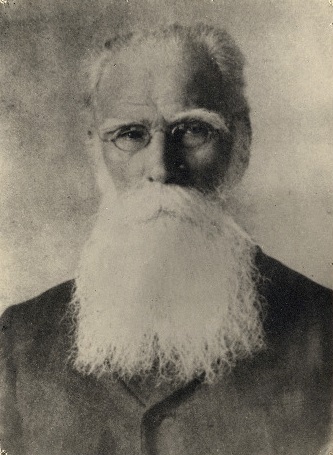
One of the most important figures in the preservation of Latvian folklore was Krišjānis Barons, often regarded as one of the central cultural figures in Latvia. A major street in Riga is named after him, reflecting his lasting influence on Latvian cultural heritage.
Barons worked primarily outside Latvia, including in St. Petersburg, and earlier in Tartu and Moscow. When German authorities realized that he was collecting Latvian folklore and folk songs, they prohibited him from returning to Latvia. As a result, Barons continued his work from abroad while others collected material within the country and sent it to him.
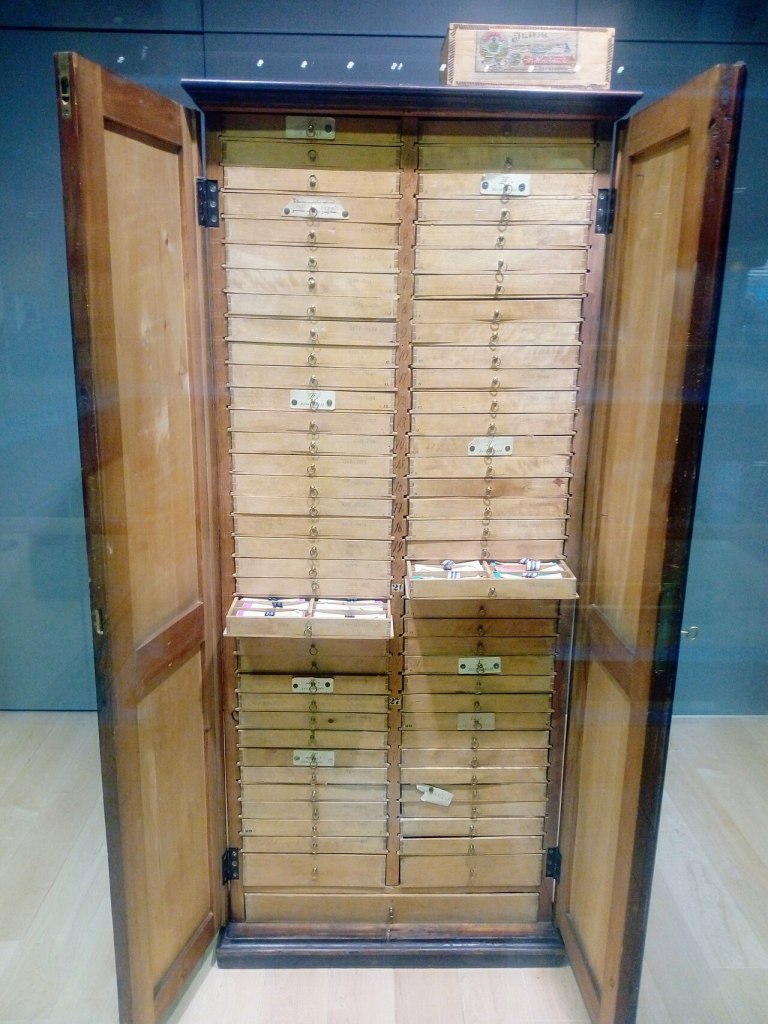
The collected songs were stored in an iconic cabinet containing numerous small drawers, each filled with written folk songs. This archival system allowed Barons to organize and catalog an extraordinary cultural collection. In total, more than one million Latvian folk songs were eventually gathered.
Compared to folktales and legends, which tend to change significantly as they travel across regions, the folk songs contain some of the richest mythological content. These songs are typically short poetic structures, often consisting of four trochaic lines, and they were widely known and shared among communities.
Layers of History in the Folk Song Tradition
Researchers studying these songs have discovered that they contain multiple historical layers. Archaeologists and historians have traced references within some songs back to the first centuries of the Common Era, and possibly even earlier. These connections are sometimes identified through references to archaeological artifacts, burial practices, or elements linked to Indo-European cultural traditions.
Despite centuries of Christianization and political transformation, this oral tradition preserved complex networks of mythological meaning. Because of these layered meanings, folk songs remain the most important source for the study of Latvian mythology.
Lakševic emphasized that when scholars analyze Latvian mythological traditions, they often rely primarily on these songs. Their brevity hides remarkable depth, allowing them to encode cosmological ideas, ecological relationships, and ritual practices within simple poetic forms.
Cultural Diversity Within Early Latvia
The diversity of Latvian folk songs also reflects the cultural diversity of the region before the emergence of a unified Latvian identity. In the 12th century, the territory that is now Latvia consisted of several different groups with distinct cultural practices and worldviews.
Over time, these groups merged into what is now understood as the Latvian-speaking population. However, linguistic and cultural differences persisted. One notable exception is the Livonian people (Livs), who speak a Finno-Ugric languagemore closely related to Estonian rather than Latvian.
Even among groups that spoke early forms of Latvian, traditions and ritual practices varied significantly. Different communities had their own ways of interacting with the more-than-human world, shaping unique relationships with landscapes, animals, celestial bodies, and spiritual forces.
For this reason, Lakševic emphasized that when he speaks about Latvian ecomythology, he is not referring to a single unified belief system. Instead, it represents a multiplicity of traditions, practices, and cosmological understandings that developed across different regions and historical periods.
Early Descriptions of Baltic Beliefs
Some early written descriptions of Baltic beliefs come from foreign observers. One example comes from Sebastian Münster, a 16th-century writer who described Livonian peasants as people who did not worship a single Christian God but instead venerated various natural elements.
According to Münster’s account, one person might worship the sun, another the moon, another might venerate a tree, and another a stone. While his description was simplistic and lacked deeper understanding, Lakševic suggested that it still captures something meaningful about the worldview reflected in Latvian folklore.
Stones, Water, and the Living Landscape
Returning to the earlier discussion of water and stone, Lakševic explained that stones in Latvian folklore are often portrayed as sensitive, responsive, and alive. They are not merely inert objects but important cosmological actors within mythological narratives.
A striking example appears in the work of the Latvian painter Janis Rozentāls, one of the most celebrated artists in the Latvian artistic tradition.
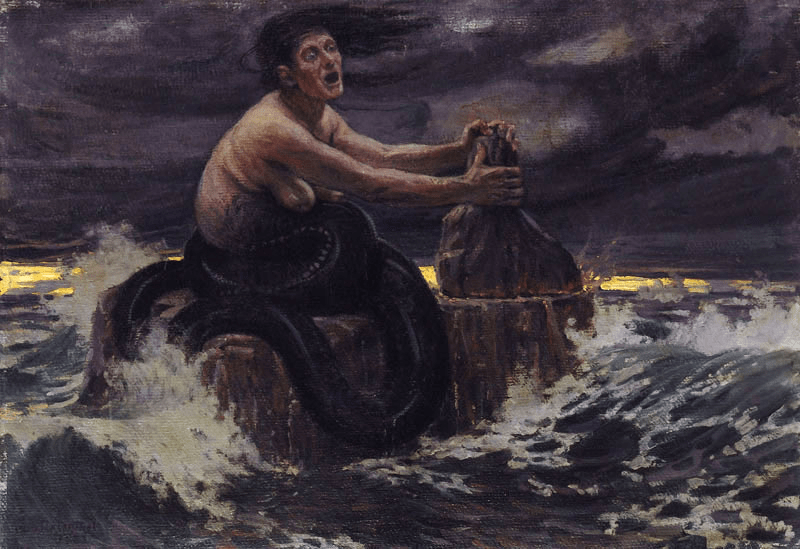
One of his paintings depicts a mythological scene in which a black grass snake grinds something in the middle of the sea while standing on a stone. This stone, located at the center of the sea, represents a key cosmological place within Latvian mythological imagination.
Through such imagery (whether in songs, art, or stories) the Latvian tradition portrays a world in which stones, rivers, animals, and celestial bodies all participate in shaping reality. Rather than separating humans from nature, these traditions emphasize the deep interconnectedness between people and the more-than-human world.
Latvian Ecomythology and the More-Than-Human Perspective
Taken together, these traditions reveal a worldview that resonates strongly with contemporary discussions of more-than-human ecology. Latvian folklore does not place humans at the center of existence. Instead, it portrays humans as participants within a wider network of relationships that includes rivers, stones, forests, animals, and celestial forces.
By studying these traditions, particularly the vast archive of folk songs, researchers can uncover ways in which historical cultures understood their environments not simply as resources but as living, relational worlds.
Lakševic’s exploration of Latvian ecomythology therefore offers more than a historical overview. It provides insight into how myth, ecology, and cultural memory intertwine, revealing alternative ways of understanding the relationship between humans and the landscapes they inhabit.
(to be continued)
Join us in Latvia – summer 2026
- This lecture is part of the Nordic Summer University (NSU) – Winter Symposium 2026 of Circle 5
- Our summer symposium (24-31 July) 2026 will take place in Latvia … and we love to have you there.
- Applications are open until April 1st: learn more here: https://www.nsuweb.org/circle-5-ecology-of-transformative-learning-practices-with-in-a-more-than-human-world/
- In our current crowdfunding campaign (until April 17th) for our first care(work)book focused on writing(with)plants, we have a special package, called Linden, for people who are in Riga or Saulkrasti 22-30 July. Visit the crowdfunding campaign here: https://www.ulule.com/writing-with-plants-the-book
- If you like this blogpost, but do not need the book, please consider to support our volunteer work by paying an Oak reward of 10 euros.
- If you are interested in the concept of eco+mythology, consider to subscribe here to our eco+mythology newsletter.
Discover more from Stories from the Wood Wide Web
Subscribe to get the latest posts sent to your email.
 Stories from the Wood Wide Web