Our summer symposium 2026 will take place in Latvia. Therefore, during our NSU circle winter symposium on Eco-mythology (17-18 January 2026), Kārlis Lakševics, a lecturer at the University of Latvia, shared ideas what an Eco-mythology in Latvia envelopes. This presentation includes the English translation of knowledge which is only available in Latvian.
Using the Daugava River and a Latvian folk song as examples, he explains how rivers, water, stones, trees, and celestial bodies appear in folklore as active agents connected to life, death, cosmology, and human experience. He argued that Latvian mythology is preserved primarily in a vast tradition of folk songs, which maintained older cosmological ideas despite Christianization and successive colonial periods. In the 19th century, scholars collected over a million of these songs, revealing multiple historical layers and regional variations in beliefs and practices. Overall, the talk highlighted how Latvian folklore and art express a worldview in which humans and natural elements are deeply intertwined within a shared ecological and mythological system.
Research Across Anthropology, Ecology, and Ritual
Lakševic introduced himself as an anthropologist working across multiple fields simultaneously. His research spans environmental anthropology, the study of built infrastructures, and the anthropology of religion and ritual. Rather than treating these areas separately, he aims to bring them together to explore broader questions about how humans relate to their environments and how cultural traditions frame those relationships.
This interdisciplinary approach shapes his attempt to provide an overview of two interconnected topics:
- how we might think about the “modern human”, and
- how we might understand Latvian mythology, particularly in ecological and more-than-human terms.
Before diving deeper, he asked the audience to reflect on a simple question: What do you actually know about Latvian mythology? For many people outside Latvia, the answer is likely “not much.” A major reason for this is accessibility. Most research and archival materials related to Latvian mythology remain in the Latvian language, and relatively few translations exist. As a result, part of Lakševic’s role in the lecture was essentially that of a translator, he clarified, bringing together the work of previous researchers and making it accessible to a broader audience.
Beginning With an Imaginative Exercise
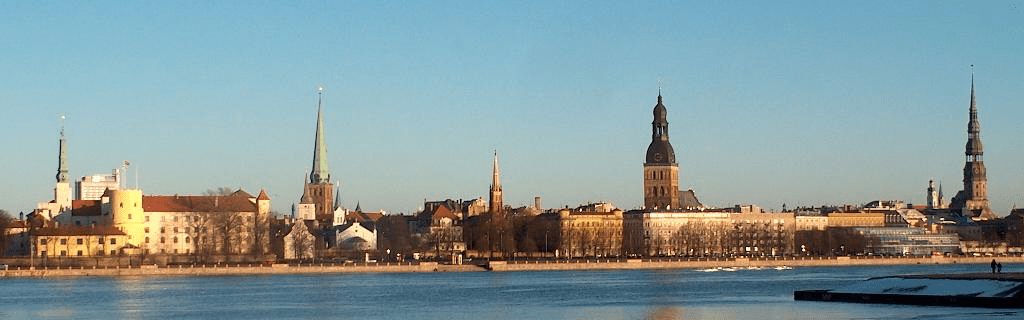
To introduce Latvian mythological thinking, Lakševic proposed an imaginative exercise centered on a place deeply connected to his own life: the Daugava River, the largest river in Latvia.
The name “Daugava” itself carries an ancient etymological meaning. Historically, dauga referred to something large or great, meaning the name effectively translates to “the great river.” Although this etymological meaning is no longer used in everyday language, it still reflects the river’s historical significance.
Importantly, in Latvian folklore the word Daugava does not always refer specifically to the physical river flowing across the country. In some contexts it simply means “the big river,” representing a broader symbolic presence within mythological imagination. Because of this, the Daugava occupies a central place among the mythical beings and forces appearing in Latvian folklore.
Listening to a Folk Song of the River
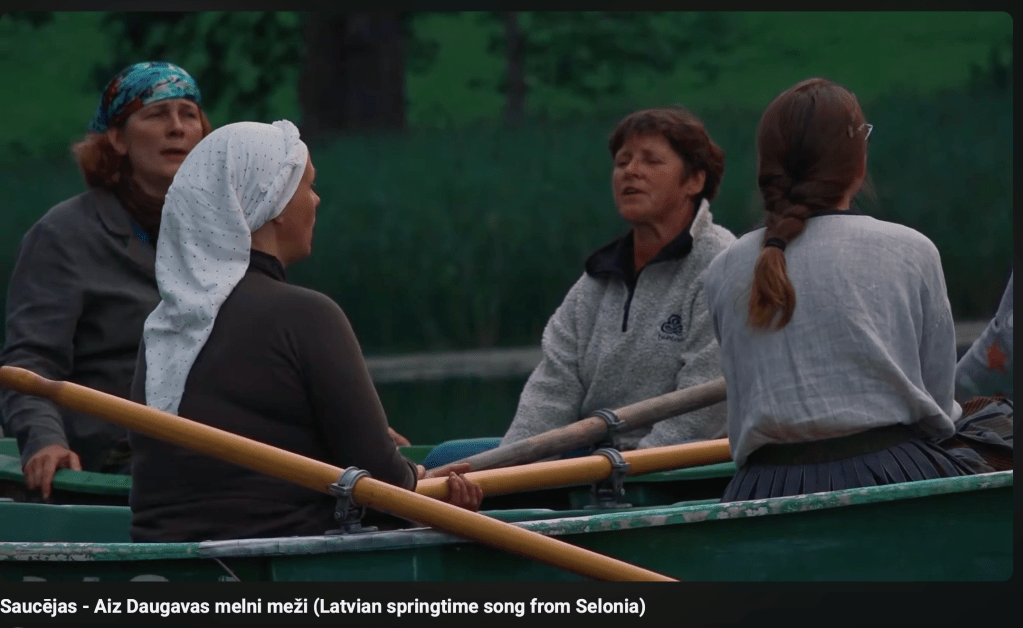
Lakševic introduced the audience to a Latvian folk song performed by the folk collective Saucējas. The song appears on the group’s album Daba (“Nature”), which features recordings made outdoors in forests, meadows, and near water bodies. These recordings intentionally preserve the environmental sounds of the landscapes in which they were performed, reflecting the fact that Latvian folk singing historically took place not only indoors but often directly within natural environments.
The specific song, titled “Aiz Daugavas,” roughly translates to “Beyond the Daugava.” The lyrics describe a narrator who longs to cross the river toward the dark forests on the other side. Lakševic asked the audience to listen carefully and reflect on two questions:
- What elements in the song feel distinctly human?
- What elements might be considered more-than-human?
These reflections were accompanied by visual references to Latvian paintings depicting landscapes and people, including works by well-known Latvian artists. The images showed how rivers and landscapes are frequently portrayed alongside human communities, emphasizing the deep relationship between people and their environments.
The Daugava River as a Mythological Being
Within Latvian folklore, the Daugava carries numerous meanings that extend far beyond its physical presence as a river.
Historically, the river has been referred to as “Likteņupe,” meaning “the River of Destiny.” In this sense, the Daugava is imagined as a witness to everything that has happened along its banks: wars, suffering, migration, and the everyday lives of people who lived nearby. Its historical importance is reinforced by places such as the Island of Death, located near the river and associated with wartime events.
The city of Riga, located where the Daugava meets the sea, also reflects the region’s complex colonial history. The city was established during a wave of colonization beginning in the 12th century, when German settlers built urban settlements on the lands of Indigenous Baltic peoples such as the Livs. The territory that is today Latvia originally consisted of several different cultural groups that were not yet unified under the identity “Latvian.”
Within folk songs, the Daugava takes on many additional symbolic forms:
- It appears as the river that souls cross after death, functioning as a boundary between worlds.
- It is sometimes depicted as a place where children are found or “fished out”, reflecting symbolic associations between water and birth.
- In older Latvian traditions, infants were sometimes given protective names derived from fish, highlighting the deep symbolic link between human life and water.
Lakševic pointed out that these associations resonate with the biological reality that human life develops in water before birth. In this sense, folklore reflects a deeper understanding of humans as fundamentally watery beings.
Cosmology Along the River
The Daugava also appears in songs as a location where the world tree stands, often imagined as a great oak growing near the river. Latvian folklorists typically refer to this as the world tree rather than the “tree of life,” though the symbolic structure resembles similar cosmological trees found in other mythologies.
In this mythological landscape, the river is not only a natural feature but also:
- a meeting place for celestial beings,
- a boundary between worlds, and
- a site of transformation, particularly in songs about marriage or life transitions.
Crossing a river in these narratives often symbolizes moving between states of existence, between life stages, between communities, or between the human world and other realms.
The river even appears in magical spells known as buramvārdi. In these healing incantations, the Daugava may represent the flow of blood in the body. When attempting to stop bleeding, the river becomes a metaphor for circulation and the restoration of balance.
Human and More-Than-Human Dialogue
By examining these examples, Lakševic demonstrated how a single natural feature, the Daugava River, embodies multiple layers of meaning within Latvian mythology. It contains both life-giving and destructive powers, nurturing and dangerous aspects, and human as well as more-than-human significance.
Many folk songs even depict conversations between humans and natural forces. In some cases, a person calls upon the Mother of Water, asking her not to take the soul of a drowning brother. In other songs, humans converse with the sun or other cosmic entities.
These narratives reveal a worldview in which the boundaries between humans and non-human forces are fluid and intertwined. The landscape itself participates in dialogue, making it difficult to clearly separate human actors from the wider ecological world.
Water as the Primordial Substance
Lakševic’s own research has focused extensively on water in Latvian folklore, including collaborative work with philosopher Hans Sauk. In many Latvian folk songs, water appears as the primordial substance from which the world emerges.
Some songs describe the meeting of water and stone, presenting elemental forces rather than human actors. One such verse describes water striking a stone on a sacred day, with the stone responding by shaking its head. Although no humans appear in the scene, the elements themselves behave almost like living beings.
These poetic images illustrate how Latvian folklore often portrays the material world as animated and relational. Stones, water, and other elements are not inert objects but participants in the formation of the cosmos.
Along the Latvian coast, large stones in the sea further reinforce these mythological images. One of the largest sea stones can be found along the Kurzeme coast of the Baltic Sea, serving as a tangible reminder of the geological features that inspired many of these stories.
Why Folk Songs Are the Core of Latvian Mythology
Lakševic emphasized that folk songs are the primary source of Latvian mythology. While archives contain many folktales, legends, and stories, the songs themselves preserve the richest mythological material.
It is possible that earlier forms of narrative, such as sagas among medieval elites, once existed. However, if they did, they did not survive the waves of colonization that reshaped the region. What remains instead are scattered historical descriptions written by outsiders, especially German chroniclers, whose accounts must be treated cautiously due to their biased perspectives.
Despite these limitations, the surviving folk song tradition offers a remarkable window into the mythological imagination of the region. In the next part of the lecture, Lakševic turns to the historical processes through which these songs were collected and preserved.
(to be continued)
Join us in Latvia – summer 2026
- This lecture is part of the Nordic Summer University (NSU) – Winter Symposium 2026 of Circle 5
- Our summer symposium (24-31 July) 2026 will take place in Latvia … and we love to have you there.
- Applications are open until April 1st: learn more here: https://www.nsuweb.org/circle-5-ecology-of-transformative-learning-practices-with-in-a-more-than-human-world/
- In our current crowdfunding campaign (until April 17th) for our first care(work)book focused on writing(with)plants, we have a special package, called Linden, for people who are in Riga or Saulkrasti 22-30 July. Visit the crowdfunding campaign here: https://www.ulule.com/writing-with-plants-the-book
- If you like this blogpost, but do not need the book, please consider to support our volunteer work by paying an Oak reward of 10 euros.
- If you are interested in the concept of eco+mythology, consider to subscribe here to our eco+mythology newsletter.
Discover more from Stories from the Wood Wide Web
Subscribe to get the latest posts sent to your email.
 Stories from the Wood Wide Web