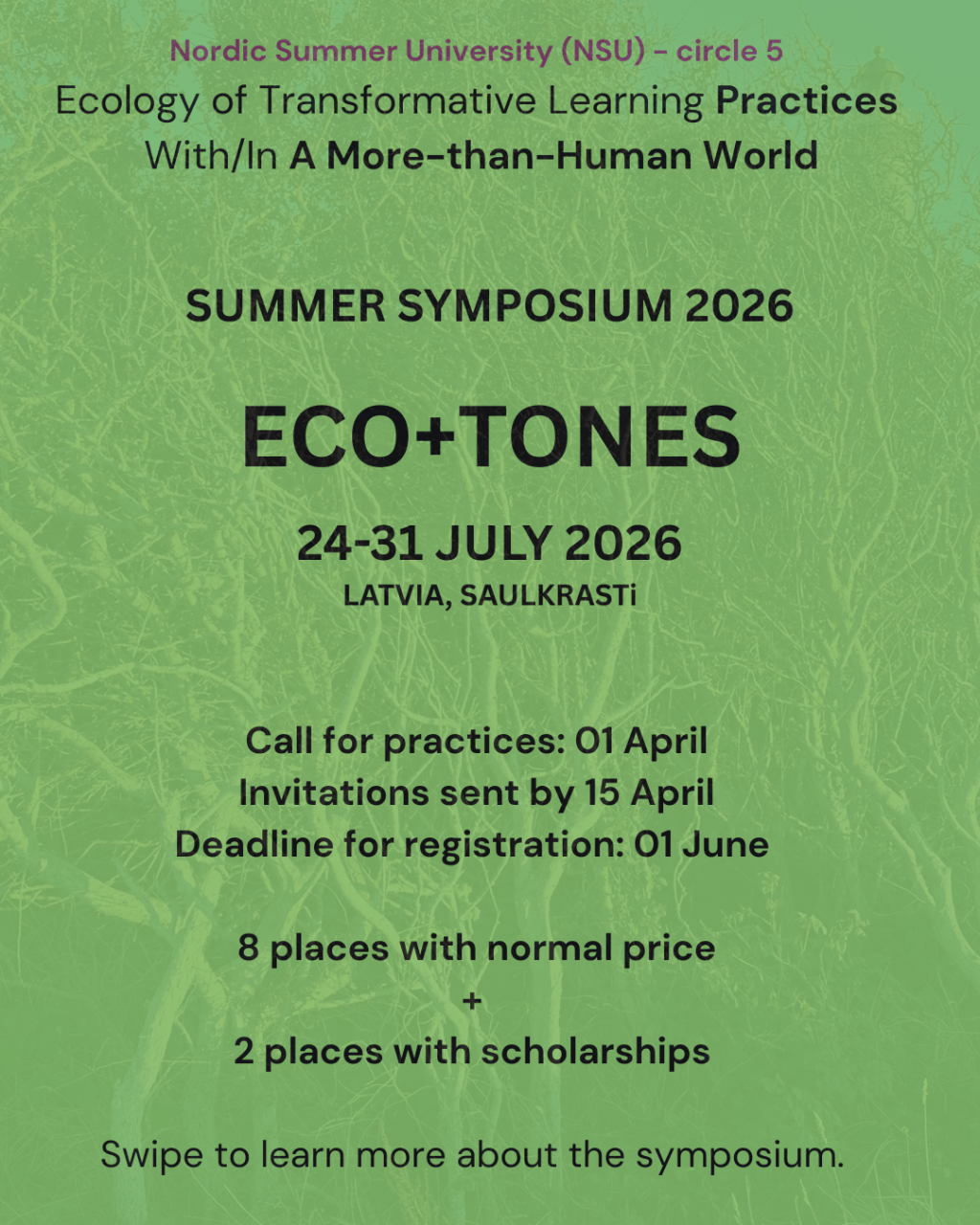
Hosted by the Nordic Summer University Study Circle 5: Ecology of Transformative Learning Practices with/in the More-than-Human World
In hyperindividualised societies most of us are trained into super-autonomy and lose capacities to care for self, other people and more-than human world. How do we learn together to perceive our interdependencies and how do we practice skills of caring for each other, learning, studying, working, living together?
This symposium is part of the ongoing work of our Nordic Summer University study circle on the Ecology of Transformative Learning Practices with/in the More-than-Human World.
Hence, we want to foreground especially the practice. We value theory, but we think it is powerful to play and experiment with practices.
We also work with this idea of the carrier bag or cauldron. During every symposium, we add more words and knowledge in our cauldron. During the last summer symposium in Finland, we explored eco-nomy. During the winter-symposium 2026, we worked with eco-mythology. Now, we want to play with the idea of eco-tones.
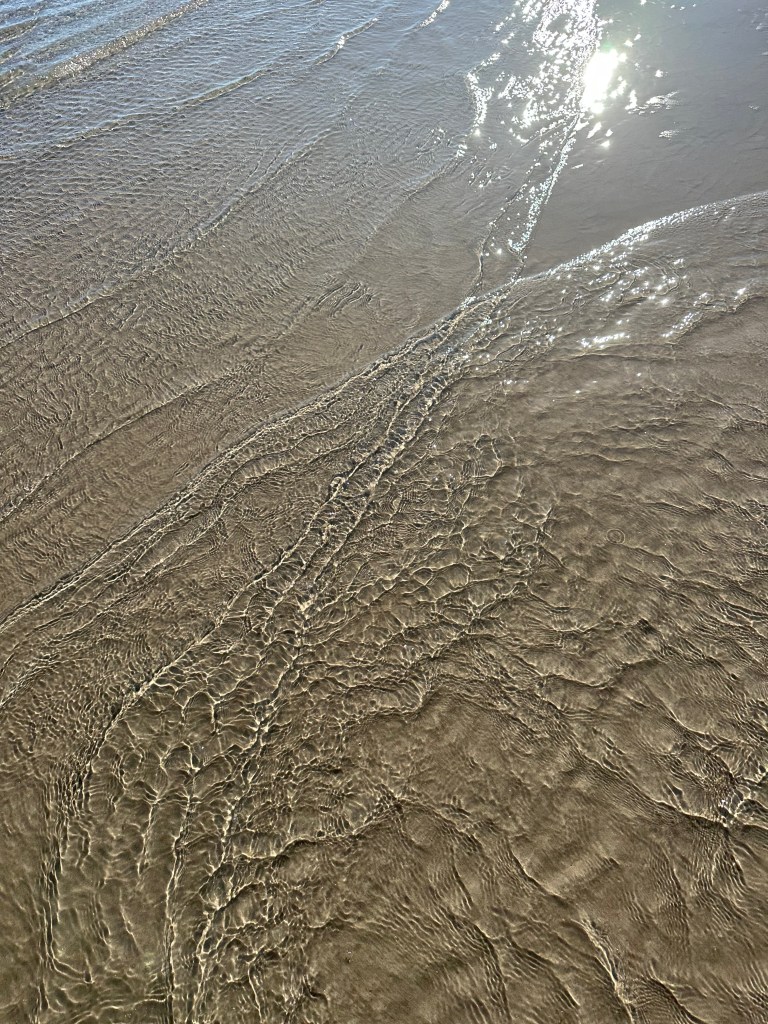
The keyword is eco+tones: where home meets new, unknown, unseen tensions and possibilities emerge
Eco+tones are zones of encounter. The prefix eco, from oikos, speaks of home: the place we inhabit, the watershed that holds us, the landscapes (human and more-than-human) that sustain life. Tones, by contrast, signal tensions: pain points, frictions, dissonances, but also cracks through which new possibilities can emerge. Tone also refers to the general character of atmosphere or attitude of a place, piece of writing, situation.
In ecology, ecotones are described as “environmental inner limits, zones of changing ecological landscapes and intermediaries, transition zones between adjacent ecosystems where species co-mingle” (Seidman, 2009). They can appear as haloclines, such as the meeting of the North Sea and the Baltic Sea, or as liminal cultural landscapes like Satoyama, where human and more-than-human worlds intensely intertwine (Wuyts, 2024; Gan & Tsing 2018). Other human scholars have been looking into swamps as liminal queer spaces where weird things can happen (Chawrilska & Dolphijn, 2025; 2026; forthcoming).
It is precisely in such spaces that conflicts, negotiations, and transformations most often unfold.
One of us (Wuyts, 2024) illustrated how forest bathing as a situated practice enabled her to experience Satoyama as an ecotone, not only as a site of knowledge creation, but also as a space for receiving care and feeling reinforced affordance for self-care. Similarly, in co-creation projects, several of us have encountered how messy, edgy, and emotionally charged this work can be, particularly when engaging with contested boundary concepts such as health, nature, and knowledge (Selliah et al., 2022). Yet it is often through (-and not despite!) these tensions and pain points that transformation and expansion of the perceptual frame occur.
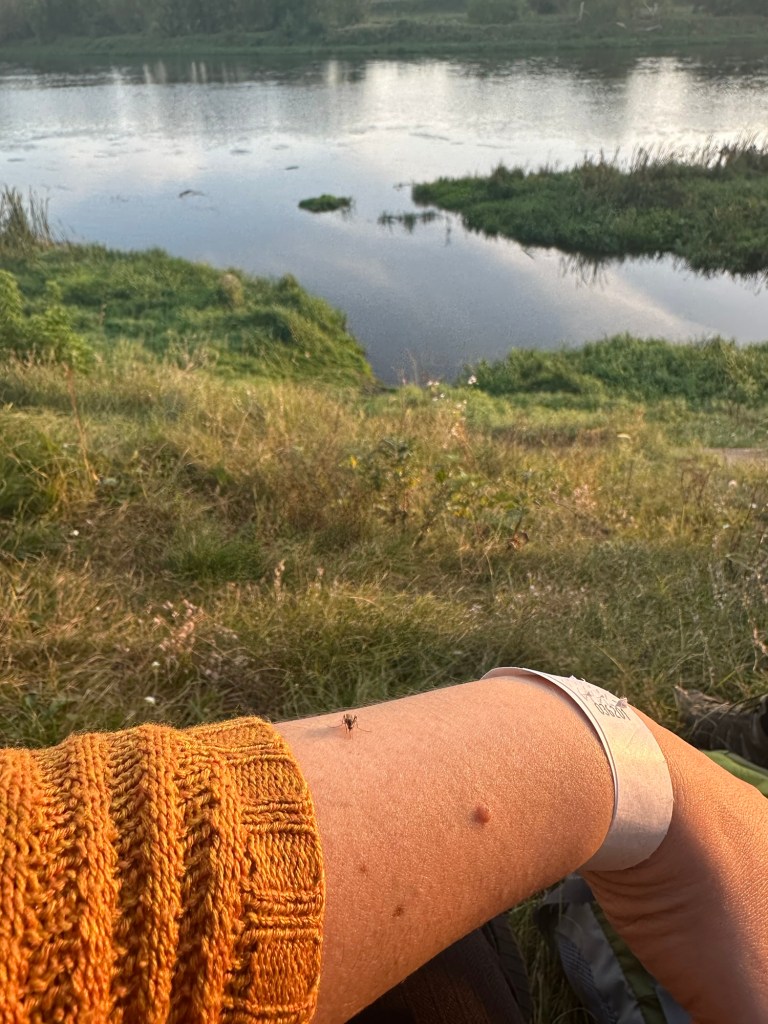
At the same time, we must remain attentive to the invisible costs of this care work: the emotional labor of holding tensions, navigating uncertainty, and translating pain into something generative. What does it take to stay with these ecotones, and who bears the weight of that work?
In this symposium, we invite participants to find and experience Eco+tones, by experimenting and playing with landscape-engaging practices, and by supporting one another in personal and collective projects embedded within the larger ecotones of our worlds. Here, we explore ecotones not only as sites of friction, but as thresholds and methodologies (Denning, 2021) where new relations, insights, and futures can take shape.
Our objective
This week-long summer symposium aims:
- to bring diverse perspectives on EcoTones as places of transformative learning of communing within more-than-human world
- to engage into practicing flexibility and stretching edges of our perception of ecology of communication, integrity and care processes
- to invite into sharing of lived experiences in conversations that honour tensions experienced in communing processes
The symposium invites scholars, artists, educators, designers, architects, farmers and other practitioners to join in co-creating studying and learning together spaces that honour edge work and tensions that may emerge.
During that week we especially focus on the arts of noticing and related practices by observing our individual and collective habits that emerge in our relationships and common work from hyperindividuality and super-authonomy that can be predatory and life/vitality-breaking.
In the past years, we collected some new questions that we might want to discuss in this symposium:
- What tensions (emotional, mental, physical, material, economical, ecological, familiar, unfamiliar…) those habits or patterns of habits create and how do we stay with them (Donna Haraway) or learn to release them together?
- What can we learn from mycelial networks about the ecology of communication?
- How can bioacoustics and new modes of communication, especially deep listening and sensing, help us hybridise edges in academic spaces?
- What are survival tactics in a world of forbidden words, like climate, gender, woman, queerness? How do we educate the skill of understanding subtext, as a survival skill where being different can be dangerous? How can we hide ‘forbidden knowledge’ in plain sight?
- How do we deal with tensions in co-creation processes?
- Which frameworks, ethical codes, new rituals and ceremonies (calibrated to the needs of today’s world) can help us deal with challenges around co-habitation with the more than human world?
- …

Our format
This week, we want to create a space to help each other, where learning to ask for help, receiving offered help or expressing gratitude for asked or offered help can be practiced. That is why we will design a programme with enough time for observing, noticing, resting and processing, but also for your personal projects, play with your family and friends, and care-work.
A typical day would look like this:
| First morning session (1,5 hours) | We try out a practice, preferably outdoors |
| Second morning session (1,5 hours) | We read and discuss a draft of someone’s paper, funding proposal, slide deck, short story… (every day, we focus on another’s personal project) |
| Afternoon | We explore other study circles, we rest, we do care-work, we work on your personal project, we attend general assembly or other meetings, etc. |
| Evening | Cultural programme for all study circles |
There is one excursion day. So, we would have only five days like this.
Every morning, we would like to start with a nature-based practice (1,5 hour time slot). This can be a guided forest bath, a drawing session, a body movement course, a gratitude ceremony… or sitting outside and doing a fish bowl, under a birch tree, and listening to the crickets. It can be very simple. That is why we encourage you to apply with a proposal of which practice you can facilitate in the morning. No worry, if you do not feel ready to guide a practice yet, and rather want to join in our circle to get inspiration.
After the coffee break, we have another 1,5 hour time slot. We would plan collective reading and editing of each other’s personal projects. After lunch, you can join sessions of other study circles, the general assembly, enjoy the Baltic Sea, do some writing, reading, foraging, relaxing… .
In the evening, there is a shared cultural programme for all the 10 circles of NSU.
Time for your personal projects
We want to create space and feedback systems for you to tend your personal project. This can be a draft of an academic paper, funding proposal, poem, course curriculum, a ritual, a new ceremony, business proposal, short story, scenario pitch…
When you apply in February-March for a spot in our circle, ask yourself:
What do we want to learn or get out of this?
Here are the tentative examples of the personal projects of a few coordinators:
- Wendy: work on a course curriculum and hydrofeminist fiction project on Eglė.
- Vitalija: prepare the winter symposium 2027 plan
- Heide: work on a funding application with plants as elders
Location:
- Minhauzen Unda, Ainažu iela 74, Saulkrasti, Latvia.
- 1 hour by public transport from Riga, the capital of Latvia.
- Learn more in this video about the eco-mythology of Latvia, thanks to this recorded keynote during our winter symposium 2026.
Key dates:
- Submission of your application: 01 April 2026
- News about acceptance and scholarships: 15 April
- Registration summer symposium: 01 June
- Summer symposium: 24 July (afternoon/evening)- 31 July (morning)
Pricing
We work with various prices. This depends on the type of room that you will use (comfort and family size). A ticket needs to be purchased via the NSU webshop – but only after an invitation.
- 100 euros Scholarship [x2 per circle] in shared 4-bed rooms with shared bathroom >> Visit this page to learn more.
- 1250 euros Institutional price/any room type
- 900 euros Institutional price PhD/any room type
- 950 euros Single room
- 700 euros Bed in double room
- 1000 euros Double room 1 adult 1 child
- 1200 euros Family room 1 adult 2 children
- 1800 euros Family room 2 adults 2 children
- 1500 euros Family room 2 adults 1 child
- 500 euros Camping
The money will cover … accommodation, 3 meals/day and coffee, tea, water and snacks during the two coffee breaks. This does not include transport costs, or pickup from a public transport stop.
Small Nordic travel scholarship (deadline 15 feb)
If you read this before February 15th, 2026, can understand a Nordic language, and you would travel from Norway, Iceland, Denmark, Sweden or Finland to Latvia (and back), consider to apply for a travel grant (travel costs, and the above mentioned accommodation and food costs) from Letterstedtska by February 15th: https://www.letterstedtska.org/ under Ansökan nationellt:
- Ansökan Resebidrag LF avd. Danmark (resa från Danmark)
- Ansökan Resebidrag LF avd. Finland (resa från Finland)
- Ansökan Resebidrag LF avd. Island (resa från Island)
- Ansökan Resebidrag LF avd. Norge (resa från Norge)
- Ansökan Resebidrag LF avd. Sverige (resa från Sverige)
How to Apply for one of the spots in our circle?
Send your proposal (max 1000 words / 2 pages, including visuals) by 1 April 2026 to: wendywwuyts@gmail.com and vitalija.ppetri@gmail.com
Please include:
- Title and short description (3-4 sentences) of your presentation / performance / contribution
- Short bio (max 200 words)- Please let us know: Which places have you been rooting in… and which 3 non-human entities there have a relationship with you? (e.g. Wendy has been rooting in the Mjøsa region, Norway for the past 4,5 years, and had a relationship with the lake, the spruce trees and the mysterious Huldra stones. )
- What does eco-tones mean to you? Add an example of how it shows itself to you or how/when/where you notice it or experience.
- What will you share during the Summer Symposium? Description of your transformative learning practice(s) with/in a more-than-human world you propose to experience during eco-tones symposium. (See the section “format”). Please include practical details: How much time do you need? (30–90 min, teams of 2–3 welcome). However, if you do not feel ready to offer a session and rather want to join as a participant, learning from others, and work on your personal project, just share your short bio and short description of your personal project with us.
- What would be your personal project that you would like to work on/care for in your free moments during that week? (See the section ‘examples of personal projects’).
- Inspiration. Include a few key artistic and/or academic references
- If applicable, do you have a relationship with Latvia or Saulkrasti? (Relevant networks, organisations… that might want to learn more about practices wit/in a more-than-human world in Latvia?)
Creativity is welcome! Text, drawings, photo images, and poetic formats can all be part of your proposal!
Reminder: please do not forget to fill out the questionnaire about your creative more-than-human practice(s) and relationships. Your reflections will help us to better understand your work and to write our final report to the Nordic Summer University. Thank you!
Selection Criteria
By April 15th, Lisa Sattell, Heide Maria Baden, Vitalija Povilaityte-Petri and Wendy Wuyts will make the selection. In shaping the program, priority will be given to collective, intergenerational, trans- and cross-disciplinary presentations/conversations/dialogues, presenters who consider themselves young in their study field, contributions from members of our study circle, who participated in the winter symposia 2025 in Denmark, 2026 online and/or summer symposium 2025 in Finland.
We are looking forward to co-creating with you in enchanting Latvia.
Our NSU study circle newsletter
Join 130 other soul-minded subscribers by subscribing to our newsletter. You can subscribe to our newsletter here.
Further readings:
- Chawrilska, Irena, and Rick Dolphijn. “Swamp-thinking: Story-scapes on Darkness and decay” (2026). A keynote during our circle’s winter symposium 2026 on eco+mythology. The authors will publish a book in 2027.
- Chawrilska, I., & Dolphijn, R. (2025). On the Femininity of the Swamp. Reading the Monstrous Garden of Fertility, Fermentation, Decay. Przestrzenie Teorii, (43), 397–411. https://doi.org/10.14746/pt.2025.43.22
- Denning, Laura. “Ecotone as Methodology.” GeoHumanities7.1 (2021): 164-175. https://www.researchgate.net/profile/Laura-Denning-2/publication/352580282_Ecotone_as_Methodology/links/60e478a9a6fdccb74511f0ea/Ecotone-as-Methodology.pdf
- Gan, Elaine, and Anna Tsing. “How things hold: a diagram of coordination in a Satoyama forest.” Social Analysis 62.4 (2018): 102-145.
- Haraway, Donna J. Staying with the trouble: Making kin in the Chthulucene. Duke University Press, 2020.
- Mick, Meghan. “Designing Ecotones: Engaging Liminal Space in the Built Environment.” Ekistics and The New Habitat 84.2 (2024): 45-55. https://www.ekisticsjournal.org/index.php/journal/article/view/731
- Ostendorf-Rodríguez, Yasmine. “Let’s become fungal!: mycelium teachings and the arts: based on conversations with indigenous wisdom keepers, artists, curators, feminists, and mycologists.” (2023).
- Seidman, Pearl. “Vitality at the edges: Ecotones and boundaries in ecological and social systems.” World Future Review 1.5 (2009): 31-47.
- Selliah, Sugirthini, Vitalija Povilaityte-Petri, and Wendy Wuyts. “Tensions and invisible costs in co-creating nature-based health knowledge in Brussels.” Urban Science 6.4 (2022): 68.https://www.mdpi.com/2413-8851/6/4/68
- Wuyts, Wendy. “Finding Satoyama–Forest bathing as a creative practice of knowledge creation and healing in/with/through damaged landscapes.” Journal of Ecohumanism 3.2 (2024): 105-133. https://www.researchgate.net/publication/378434421_Finding_Satoyama_-_Forest_bathing_as_a_creative_practice_of_knowledge_creation_and_healing_inwiththrough_damaged_landscapes
Discover more from Stories from the Wood Wide Web
Subscribe to get the latest posts sent to your email.
 Stories from the Wood Wide Web