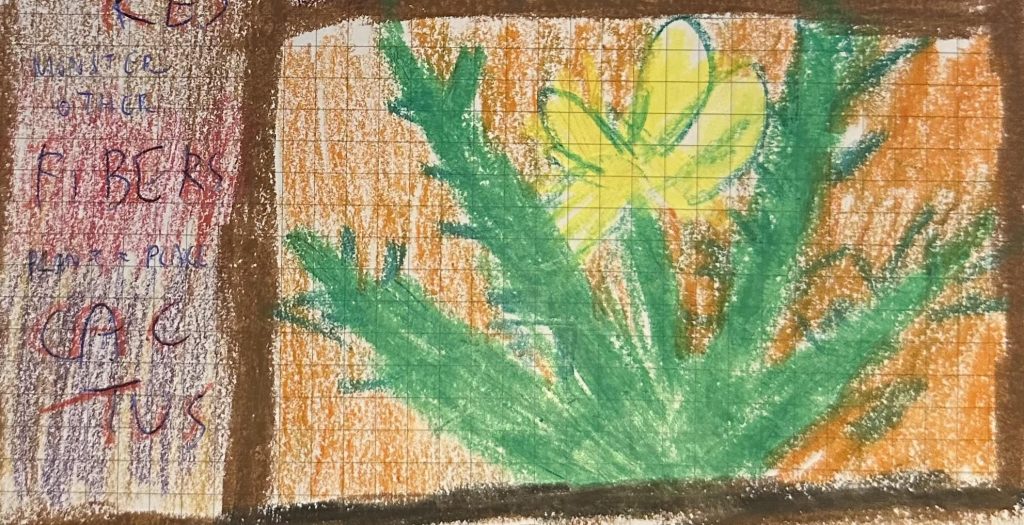
In January, Lisa Sattell hosted two sessions focused on the same plant: Medusa Head, a cactus that is, botanically speaking, not quite a cactus. She also emphasized that these were not simply writing-with-plants sessions, but writing-with-mythopoetic-plants sessions, because these plants are deeply entangled with myth.
As I understand the term, mythopoetic plants are plants that carry symbolic, mythic, or archetypal meaning, not merely botanical or medicinal value. The word mythopoetic literally means “myth-making”: such plants participate in stories, rituals, and imaginal worlds that help humans make sense of life and death, healing and danger, loss and transformation. They are plants that generate myth, or that have themselves been shaped by myth, poetry, ritual, and a long cultural imagination.
Two winters ago, our work included other mythopoetic plants such as myrrh, as well as trees connected to the Eglė myth, including spruce and birch. This winter, I also encountered Michael Marder’s Metamorphoses Reimagined. In Ovid’s Metamorphoses, many human figures are transformed into plants, and Marder revisits these stories with philosophical care and attention.
In this blog post, I want to weave together insights from Marder’s book, Lisa’s recent sessions, and my own experiences hosting similar sessions in earlier years.
But… are not all plants mythopoetic?
Even days later, we had some written and oral discussions about the concept of ‘mythopoetic plants’. One of our core team members wondered if not all plants are mythopoetic. Where do we draw the line?
This yarning resulted in me proposing a framework that I call the Mythopoetic Plant Spectrum. I presented a first draft at the Eco+Mythology Symposium on 17-18 January, and this will be worked out in our first writing(with)plants care(work)book, coming out before midsummer. Keep an eye on the newsletter.
But… let’s return to the story.
Medusa head – a story, the google version
The story of Medusa’s head centers on the Greek hero Perseus, who beheaded the snake-haired Gorgon, using her petrifying gaze as a weapon before giving her head to the goddess Athena to adorn her shield, the Aegis, as a symbol of protection and power. Originally a beautiful priestess, Medusa was transformed into a monster by Athena (in Ovid’s version) after being assaulted by Poseidon in Athena’s temple, making her a tragic figure of patriarchal violence.
Need for more eco-critical reading of myths or creation of new mobilizing eco-myths
A few days ago, two children were explaining Greek mythology to me by referring to the latest Percy Jackson movie. I found this both amusing and telling. I studied Ancient Greek for five years in high school and read some of the older written versions of these myths. Even so, I remain critical of the written sources themselves, since they are rarely the “first” versions of the stories. Anyone who studies folklore or mythology knows that there are countless—perhaps billions of—variants, yet only a few become dominant and are accepted by a general audience, often in simplified or sanitized forms. Today, this is frequently the “Disney version.”
Standing there with the children, however, I was not quite sure how to explain this without turning the moment into a lecture. More importantly, I was less interested in correcting their knowledge than in inviting them to rethink their relationship with monsters. This led us into a conversation about dragon-monsters. I mentioned that I knew Percy Jackson, casually dropped the name of another character from the film to prove I wasn’t bluffing, and then said that I personally preferred How to Train Your Dragon. What I appreciate about that film is that it suggests we do not have to behead monsters in order to deal with them.
We can also learn to befriend them, to live with them as companions.
One of the children liked this idea; the other said they did not like How to Train Your Dragon at all. Afterwards, I kept thinking (something I seem to do almost weekly, the nerd that I am) about how violent Greek mythology is. In this respect, it is not so different from many other mythological traditions. What struck me, however, is how even modern retellings, such as the Percy Jackson universe, continue to reinforce certain ideas and worldviews that may not be particularly helpful or life-affirming today. This is precisely why media literacy, ecoliteracy, and eco-critical ways of reading stories matter so much.
There are, of course, many feminist retellings of Medusa’s story, and I have read several of them. And yet, I still feel uneasy. The violence remains, and even these revisions often do not feel hopeful or mobilizing enough. One could, of course, turn to other cultural traditions with less violent narratives about women, but in the Western world Greek mythology remains extraordinarily influential. That makes it difficult to simply look away.
It was in this context that I became curious to read Michael Marder’s newest book this winter.
Michael Marder’s MetamorphosES reimagined
This winter, we got a copy from the publishers to review this new book by plant philosophy professor Michael Marder.
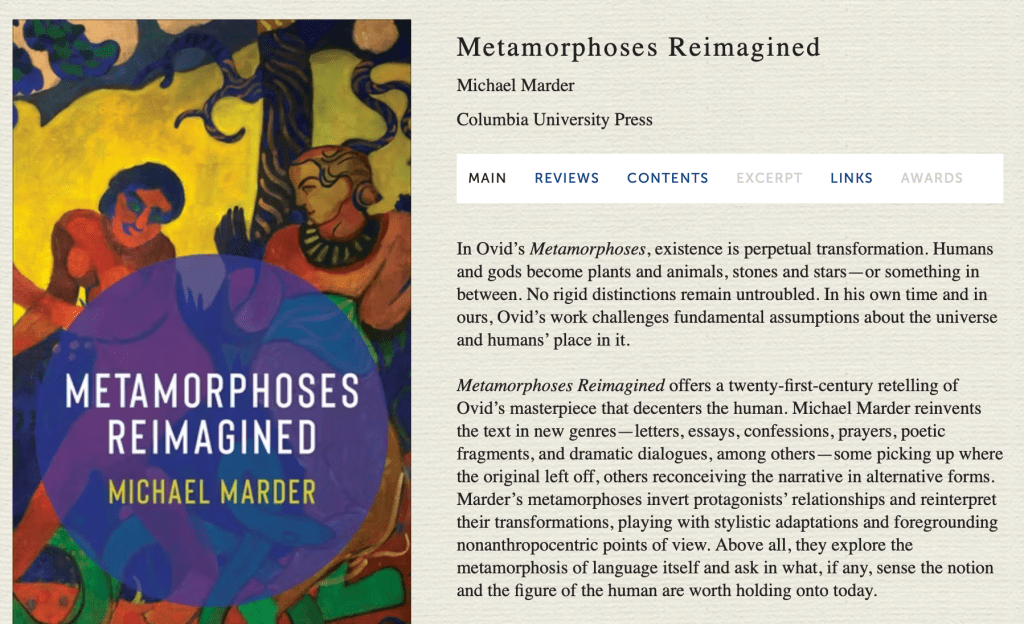
If you are still a beginner and not yet familiar with plant philosophy or the work of Professor Michael Marder, I would recommend starting with some of his other books or academic essays, particularly those on plant-thinking, but also on his concept of the dump. These texts offer important conceptual grounding and make Metamorphoses Reimagined more accessible.
In addition, Michael does not introduce the myths as they appear in Ovid in any systematic way, so it is helpful to read Ovid’s Metamorphoses in parallel. This allows the reader to better appreciate what is being reworked, reimagined, and philosophically displaced.
At the same time, I noticed a certain unease in myself. Perhaps I was missing frameworks, tools, or ecofeminist stories that could actively support ecofeminist activism or help initiate regenerative practices. I felt that something was still not quite there, something that could move from insight to action.
I have been exchanging messages with Michael about his book. After being reminded, once again, of how many women in Greek mythology are abused and then transformed into plants, I asked him why we could not imagine happier endings for them. Why must transformation always follow violence?
One cannot hide from the darkness and suffering we witness in and around ourselves, but neither will it disappear if we simply look away. As the saying goes, you have to go through the forest if you want to make it out. I can see the importance of that, even if it remains uncomfortable.
I was also brainstorming with Michael about how one might work with this book. I found myself missing instructions, prompts, or guiding questions, tools that teachers, psychology practitioners, creative writers, or bibliotherapy therapists could use in practice.
There is, in any case, a great deal of material here. This book feels less like something to be read from beginning to end, and more like a grimoire or a recipe book: not something you consume all at once, but something you return to. When you have two to four hours, when you are looking for inspiration for creative or mental health work, you can open it at almost any point, read a few pages, and begin to work with what you find.
Selected chapter: Marsh reed
One of my favorite chapters is the one about Syrinx and her transformation into marsh reed, especially because it reminds us that a plant is also a place. At the same time, it is an intensely violent story.
During our summer symposium in Finland in 2025, Michael mentioned this myth and referred back to this book, which was not published then. Syrinx transforms herself into marsh reed in order to escape Pan. Yet even then, Pan does not let her be: he turns her into a flute, and her body, now reed, continues to be used and played. I do not need to spell out the implications. The story is dark, and it stayed with me for a long time.
I am still sitting with this story.
I hope to host a session with marsh reed and Michael Marder in Marsh (Yes, I sensed the alliterations here). If this resonates with you, keep an eye on our newsletter.
Plant is place
Plant is place… and yes, Michael also emphasizes this in the chapter on marsh reed (Marder, 2025). In my own writing(with)plants book, place is a central concern. I am a geographer, so I am certainly biased, but this conviction is not only disciplinary. I have also read many scientific papers and books that explain, again and again, why place matters and how deeply it shapes life.
I will spare you the kilometers-long list of references. To summarize simply: place determines a great deal, including which plants grow where and how they grow. When you encounter a particular plant, it tells you something about its surroundings. If you see beard’s moss, for example, you know the air must be very clean. Plants are (bio)indicators, witnesses, and expressions of place.
When I host writing(with)plant sessions, one of my recurring prompts in the creative writing and arts section is to ask participants to name the place of the plant as well. Where are you?
In the book, I will also offer tools to help create more hopeful ecomythologies rooted in your own life and place. There will be prompts and white space inviting you to sketch, to write first with a pencil and then, perhaps, with a golden pen: to listen to what your place needs, and to imagine how you might help, respond, and co-create within the web of human and more-than-human relationships that already shape that place.
Writing(with) a cactus named after medusa head
Originally from South Africa, the guest plant Lisa invited is, in fact, not a cactus but a Euphorbia (Sattell, 2026). I am not a plant expert, and I had been referring to it as a cactus in my previous external communication, so my apologies. I only realized this during the session itself.
Nicknamed “medusoid” for its Medusa-like halo of snake-like arms radiating from a hypnotic apex, this plant belongs to a group of euphorbias that are especially prized among enthusiasts. The most common form is Euphorbia flanaganii. One reason for its widespread availability is that it readily produces new plants at the tips of its stems, which makes propagation relatively easy (Sattell, 2026).
I found myself playing with the plant’s place of origin. South Africa… hmm. What do I know about this place? What do I remember? And is it acceptable that I, as a highly privileged white woman, write about this plant and its place at all?
That question stayed with me, opening not only botanical but also ethical and political layers of reflection.
The Never-ending Process of writing(WITH) AND OR BECOMING (A) MEDUSA HEAD cACTUS
In this session, I found myself more in the back seat. Often, when you are the human facilitator, you do not always have the energy or inspiration to fully enter the creative space yourself. Lisa offered us a great deal to think about, and I was also still processing Michael Marder’s book. Twenty minutes simply was not enough.
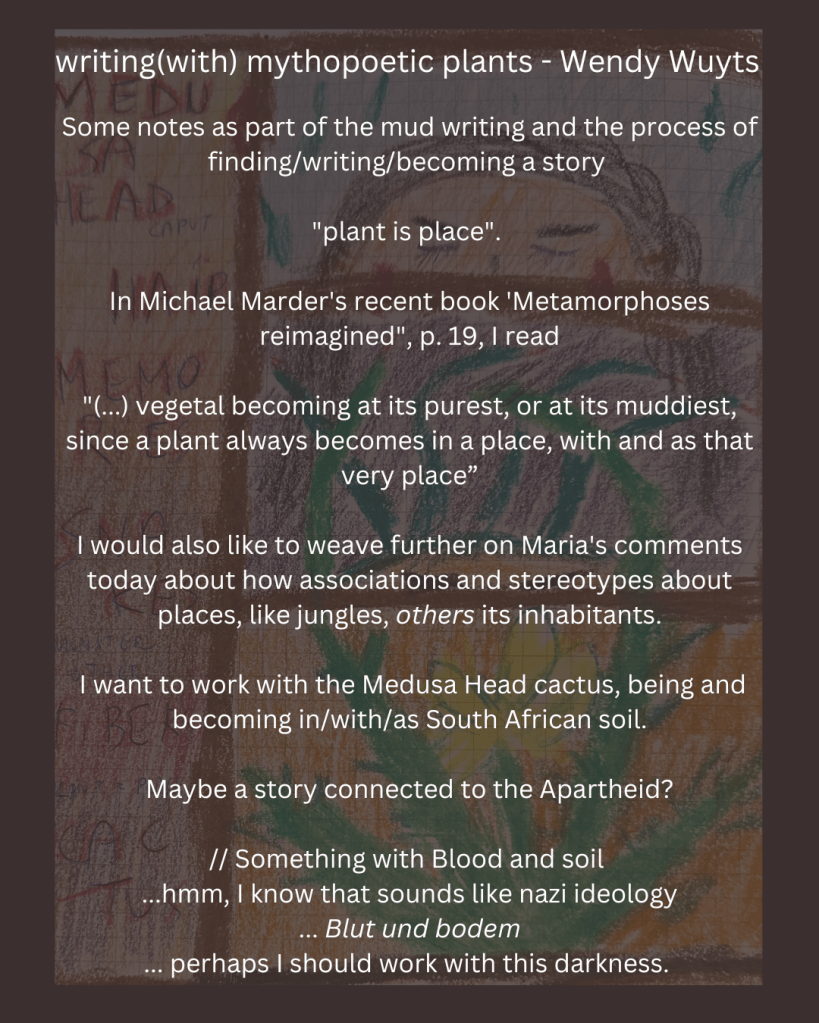
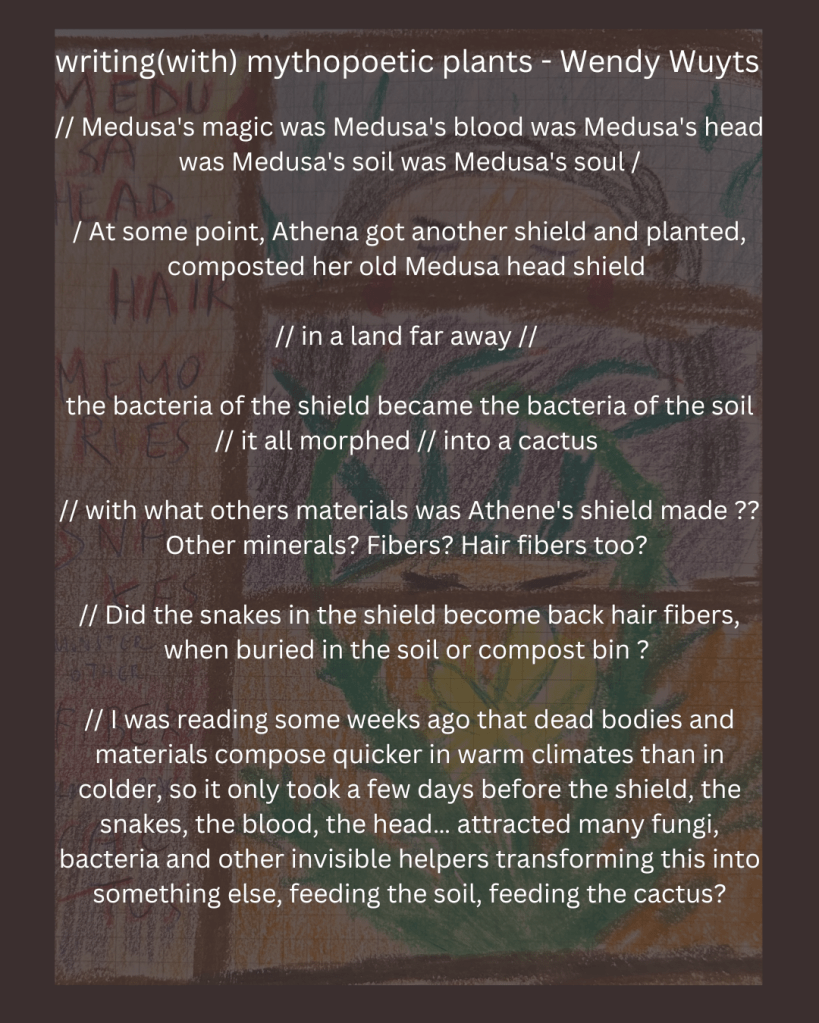
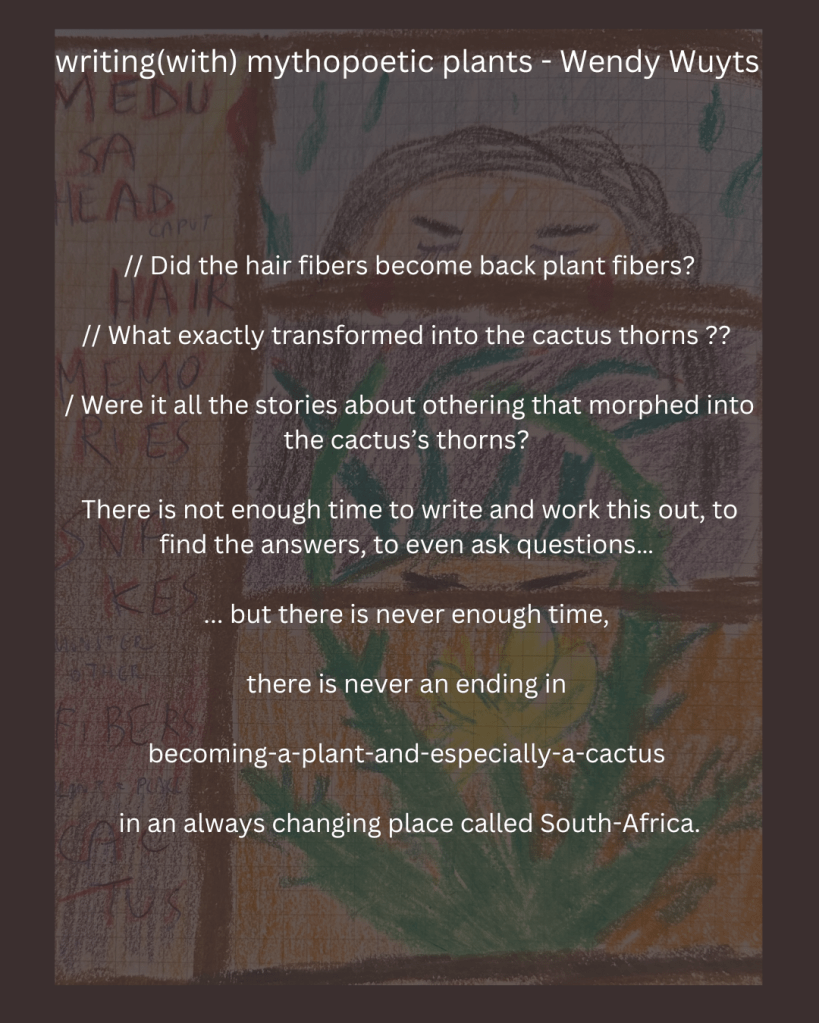
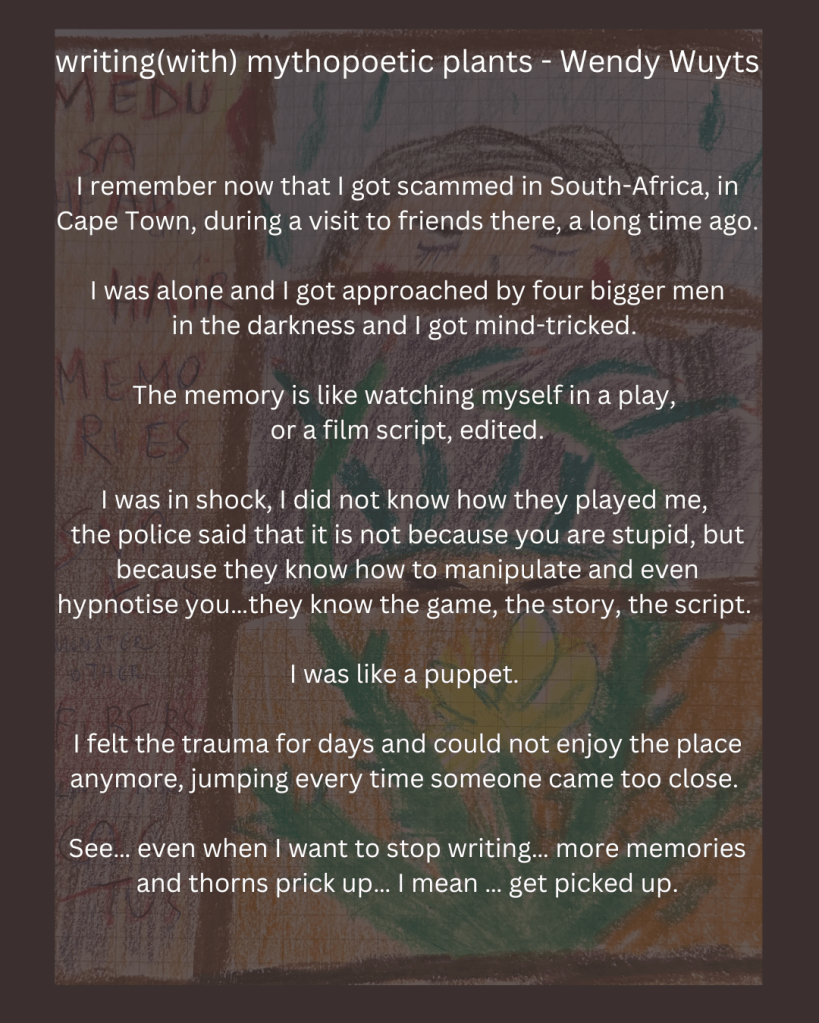
So I began by writing notes. Before I write fictional stories, I almost always start this way, by taking many notes, letting fragments and associations gather. This is what emerged during those twenty minutes.
The next day, I returned to the material. I made a drawing, added a few small details, and eventually copied it into these four graphics:
Inviting her again
When a participant had to cancel her session during our Eco+Mythology symposium, we decided to host a writing(with) Medusa Head session once again. It is always fascinating to observe what unfolds when we invite the same guest plant back into the space, this time with a different group of people. Lisa worked with the same slides as before, making only very small changes.
Around ten participants joined the session, connecting from Canada, the USA, Latvia, and Denmark, alongside the familiar co-creators and initiators Vitalija and Heide, and Alette Willis (from Restorying the Earth), who will host her first writing(with) plant session in February, with tree mallow as the guest plant.
This time, the session placed more attention on Athena and the way her relationship with snakes has shifted over time, as well as on the broader theme of fear, specifically, fear of snakes. One of Lisa’s subtle changes was the use of a different image: a snake shedding her skin. The colors in the image signaled danger (in my perception), and I shared that I found the picture frightening. Others responded that they are not afraid of snakes, or of the wild more generally. This opened up reflections on why snakes provoke fear, and how this fear might also be projected onto wild women. Just to clarify: I am not afraid of snakes in general. Other images of snakes shown during the session did not trouble me at all. What unsettled me was the particular color combination of that snake, though I cannot fully explain why. It felt instinctive. Much like a chicken somehow knows to fear a fox (yes, I may be loosely referring to a line often attributed to the mythologist Joseph Campbell), those colors were signaling danger to me. Not through reason, but through the body.
We also used a Miro board (part of the symposium infrastructure) and invited participants to leave a single line on a digital post-it. Often, we don’t know what others have written; we also know that twenty minutes is never enough to fully complete something. I added a few additional lines, such as:
Death is a human construct. From a mycelial or bacterial perspective, we might speak instead of transformation, from something into something else, from human into soil into snake into soil again into cactus.
and
The hairs of the Medusa cactus are full of memories from almost-forgotten myths of a land that no longer exists.
And the story continues…
sELECTED references
Marder, M. (2025). Metamorphoses Reimagined. Columbia University Press.
Sattell, L. (2026, January 09). Writing(with)Medusa Head Cactus. [Virtual Session] Zoom. https://woodwidewebstories.com/writingwithplants/
Sattell, L. (2026, January 18). Writing(with)Medusa Head Cactus. [Virtual Session] Zoom. https://www.nsuweb.org/circle-5-ecology-of-transformative-learning-practices-with-in-a-more-than-human-world/
Are you interested in writing(with)plants?
If you would like to join a Do-it-with-others (DIWO) session and/or learn more about the upcoming care(work)book, consider to subscribe to our newsletter, specially dedicated to the practice of writing(with)plants. We do not always announce next sessions via a blogpost, but we announce them via our newsletter and Instagram. All subscribers do get also the slides of the previous session.
Disclaimer: ChatGPT was used for language improvement, because I am not a native English speaker. I read the text carefully and made small edits. The content, experiences and thoughts are mine.
Discover more from Stories from the Wood Wide Web
Subscribe to get the latest posts sent to your email.
 Stories from the Wood Wide Web