
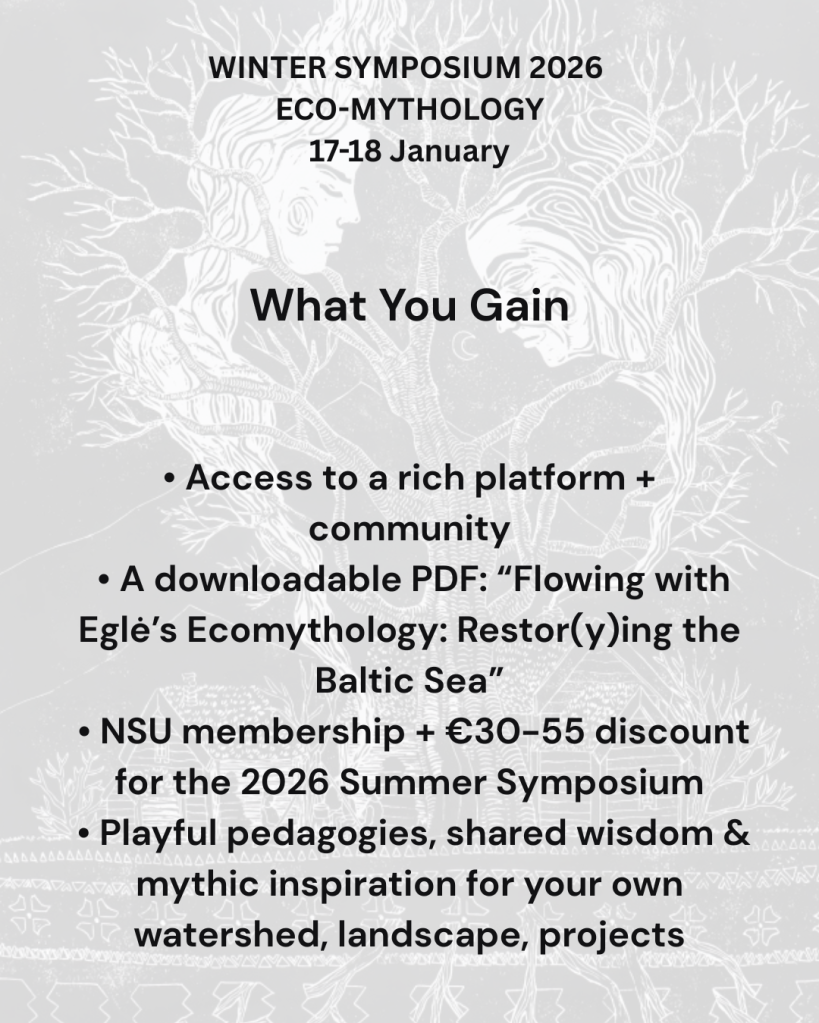
We welcome anyone on this online weekend event, who wants to learn together more what the methods are to create an eco-mythology for your watershed, city, region, neighbourhood, or your life.



The programme
Timezone: Brussels time (CET).
| Timeslot CEST | Saturday 17 January | Sunday 18 January |
| 09.00-09.30 | Wendy Wuyts: Welcome and stone soup story, explanation rules | Vitalija Povilaityte-Petri: welcome, repetition rules and objectives |
| 09.30-10.00 | Wendy Wuyts: Eglė’s Ecomythology: Restor(y)ing the Baltic Sea | Rick Dolphijn x Irena Chawrilska (TBC) |
| 10.00-10.30 | Alette Willis: Storytelling as dialogue | |
| 10.30-11.00 | Magdalena Tabernacka: Mediating entities in the non-human world around us | |
| 11.00-12.00 | Photovoice | Photovoice |
| 12.00-13.00 | Lunch break, zoom space is open | Lunch break, zoom space is open |
| 13.00-14.00 | Liene Jurgelane, Una Thorlaksdottir, Yingying He: Tuning into Birch Time: Relational Encounters with Land, Culture, and Story | Corrie Tan: The art critic as banyan: reimagining parasitic artistic practices |
| 14.00-15.00 | Long break, or time to stir the cauldron | Long break, or time to add your ingredients to the cauldron |
| 15.00.15.30 | elin kelsey and Esmé Johnson: ‘Me as We’ | Vitalija Povilaityte-Petri: discussion of photovoice |
| 15.30-16.30 | Wendy Wuyts: Intro Summer symposium Kārlis Lakševics: Keynote about a possible Eco-mythology and transformative practices with/in the more than human Latvia | |
| 16.30-17.30 | Sage Borgmäster’s book talk : Eco-Feminist Myth-Making with Estés and Blackie | Wendy Wuyts: Dreaming an ecomythology for the Nordic and Baltic region |
| 17.30-19.00 | Dinner and time to make warm apple cider/juice/tea, hot chocolate etc | |
| 19.00-20.00 | Anika Spindelmann: Apple Howling: Midwinter Wassails and Apple Cycles – Story, Ritual, and Multispecies Mythmaking |
short descriptions of each session – SATURDAY 17 JANUARY (TIME ZONE: BRUSSELS TIME)
09.00-09.30: Welcome – Offered by Wendy Wuyts (coordinator)
Wendy, one of the study circle coordinators, will open the first day. She will give a brief introduction to the Nordic Summer University (NSU), Study Circle 5, and the six symposia planned for 2025–2027.
She will outline the objectives, rules, and roles for the winter symposium, followed by the Stone Soup story. Wendy will then explain the Miro board, our shared “cauldron”, and present the overall programme of the weekend. Finally, she will introduce the photovoice invitation.
09.30-10.00: Eglė’s Ecomythology: Restor(y)ing the Baltic Sea – Offered by Wendy Wuyts (coordinator)
This session will feature a PowerPoint presentation based on an upcoming book chapter Eglė’s Ecomythology: Restor(y)ing the Baltic Sea and the forthcoming care(work)book writing(with)plants. It will introduce the Baltic Sea as an under-researched, under-storied, and potentially disenchanted region, and discuss the need for re-enchantment and re-storying, with the help of the Baltic myth of Eglė.
The presentation will outline the theoretical frameworks drawn from ecofeminism and posthumanism and address the question of why place matters, introducing the concept of relationscapes.
It will then offer a list of site-specific practices for co-creating relationscapes and developing a queer eco-mythology. A closer look at writing(with)plants will follow, including a short introduction to the upcoming book. The session will end with invitations for the weekend’s work on eco-mythology. The first invitation asks everyone to contribute to the cauldron: Which places are you rooting in, and for which places would you like to co-create an eco-mythology?
This session will be recorded and downloaded on our private Youtube after the session. The URL will be added in the MiroBoard (cauldron), so the people from especially UK and East Coast can listen to this later in the weekend.
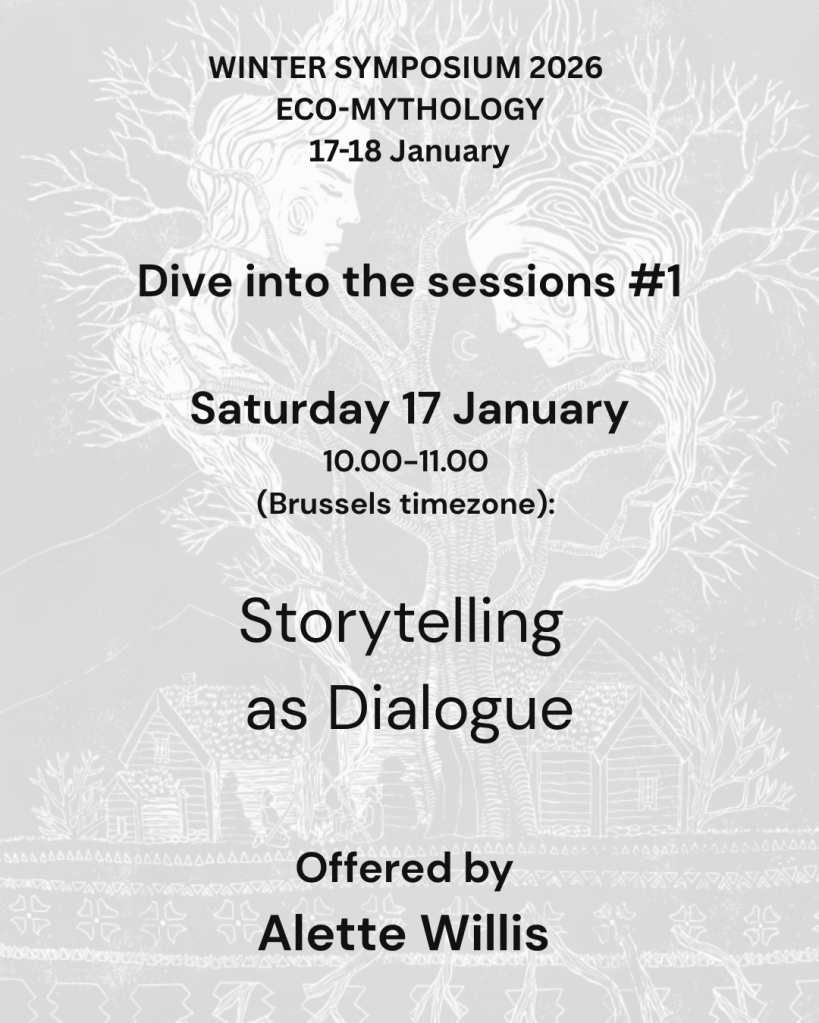
10.00-11.00: Storytelling as Dialogue – Offered by Alette Willis
In 2022, Alette, a performance storyteller, rooting in Edinburgh, with an interest in how stories can help shift communities towards more sustainable ways of being with the more-than-human-world, led a British Academy–funded research project where they worked with 55 performance storytellers in the UK and beyond who self-identified as using narrative for social change in response to today’s polycrises.
Two key themes emerged from their practices: the power of story to hold diversity within community, and the essential, dialogical nature of storytelling for social change.
In this session, Alette will guide participants through a storytelling experience shaped by a selection of these dialogical practices. Participants will be invited to take part as an ‘audience’ while attending closely to their own experience. We will then come together to reflect on what the experience revealed and how it might inform our own approaches to bringing eco-mythology into our communities.
11.00-12.00: Photovoice EcoMythology
We like to challenge the idea of indoorsy symposium where people stay inside for the whole day. Every day we reserve some time to go outdoors, so all participants have time to get enough vitamin D and also try out a method for story/data collection. All participants are invited to go outdoors, bring a camera, and create a photovoice exploration of eco-mythology. Photovoice is a participatory research method in which participants use photography to capture and reflect on their experiences, perspectives, or community issues. These images then serve as a basis for discussion, storytelling, and collective meaning-making.
Please upload your images and reflections to the cauldron. This is an invitation, not an order. You can also use this time for something else. We believe that you know what is best for you.
The zoom session will be open and Wendy will be the guardian, for all who have questions or need assistance with the cauldron.
12.00-13.00: Lunch break
The zoom session will be open and Vitalija will be the guardian, for all who have questions or need assistance with the cauldron.

13.00-14.00: Tuning into Birch Time: Relational Encounters with Land, Culture, and Story – Offered by Liene Jurgelane, Una Thorlaksdottir, Yingying He
In this session, Liene, Una, Ying, and the birch will invite participants to attune to a presence that deepens our relational engagement with the land. Drawing on artistic practices and ethnographic and phenomenological research, we will share birch stories emerged/collected from Nordic and Scandinavian cultural contexts. These stories trace how people encounter and appreciate the birch—how they think with, dwell with, and are transformed by it.
Through these encounters, the birches invite us to enter a space of collective knowing and storying, not only with human, but also more-than-human beings . Together, we ask:
- How might we, as interconnected beings, attune to birch time—a temporality that interlaces past, present, and future through the cyclical rhythms of trees?
- How do place-based relationships with birch manifest differently, yet resonate similarly, across diverse geographical and cultural contexts?
- And finally, how might these encounters be woven into more responsive and ethical ways of being human in our current era of polycrisis?
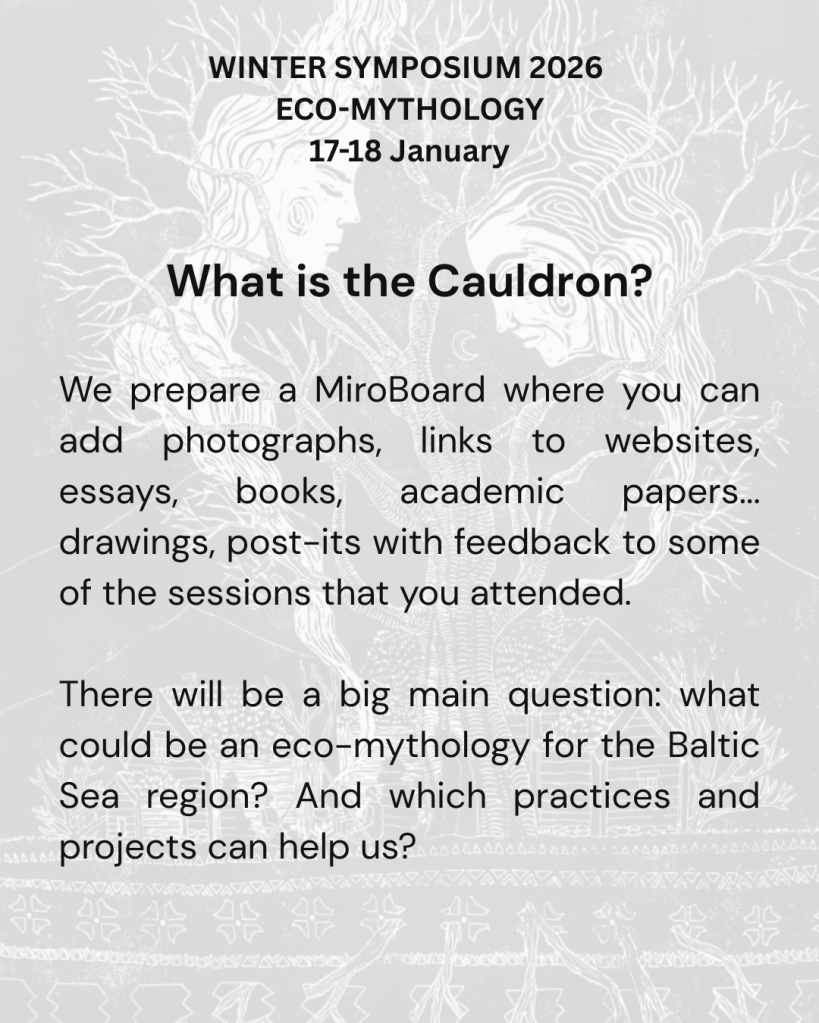
14.00-15.00: Stirring the cauldron
We know how energy-draining a Zoom session can be, so we have planned longer breaks. During these breaks, your time to stir the cauldron, you are invited to add questions, comments, feedback for the presenters, photographs, or any other “ingredients.” You can also use the time to do something else, write, or process your reflections. The zoom session will be open and Wendy will be the guardian, for all who have questions or need assistance with the cauldron.
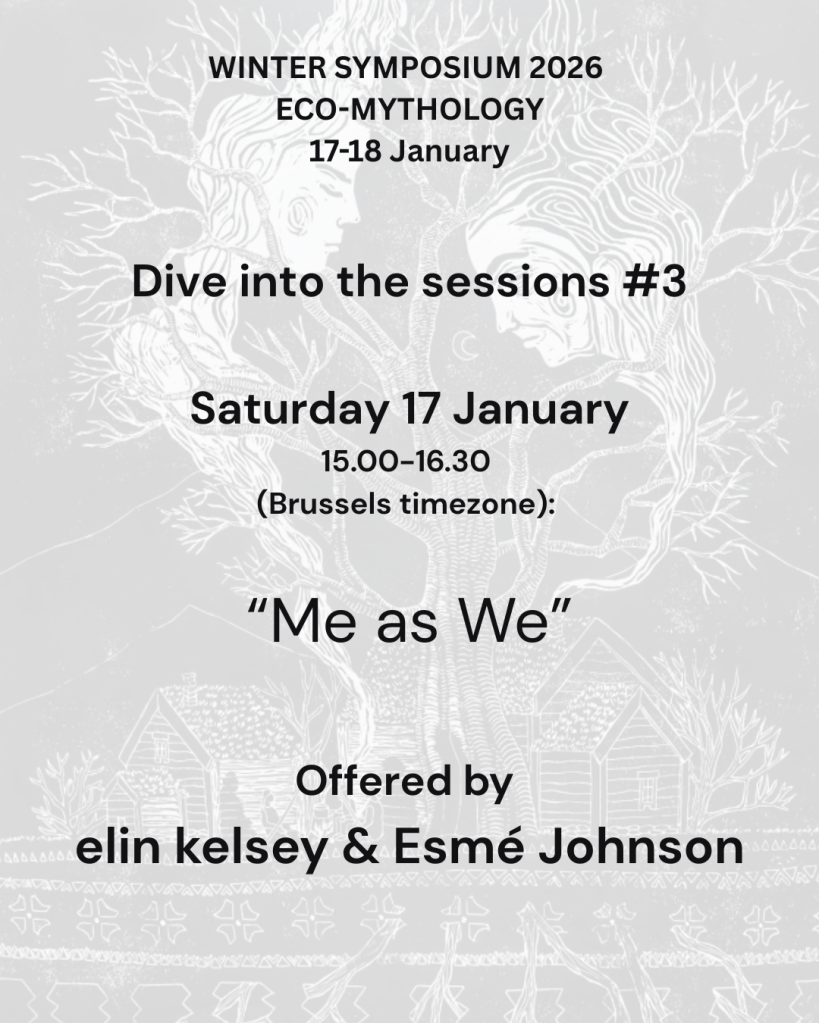
15.00-16.30: “Me as We” – Offered by elin kelsey
In this artistic session, elin will lead an art activity that invites participants to explore their more-than-human identities by creating a multispecies self portrait of themselves. Afterwards, elin will facilitate a discussion of multispecies self-portraiture, highlight a range of species that make up each of us, and draw upon the artistic capacity of her co-presenter, degrowth scholar, artist and multi-species justice advocate, Esme Johnson.
16.30-17.30: Eco-Feminist Myth-Making with Estés and Blackie – Offered by Sage Borgmästers
In this book talk, we will explore mythopoetics through a comparative walk/talk with the work of Clarissa Pinkola Estés and Sharon Blackie, guided by Haraway’s reminder that “it matters which stories tell stories.”
The workshop invites a shared inquiry into how myth, ecology, and feminist theory shape our relations with the more-than-human world and inform practices of care, kinship, and resistance. Drawing on Estés’ archetypal storytelling and Blackie’s rooted mythic imagination, we will consider why renewed myths matter and how they can help us live, and die, well in dark times. Together we will ask: Which characters and narratives help us stay with the trouble now? What shifts when we move from heroic conquest to collective, cyclical, and entangled paths? Using a diffractive methodology (Barad; Murris & Bozalek), and grounded in Le Guin’s Carrier Bag Theory and Haraway’s sympoiesis, we will approach myth as holding not only stories but also seeds for co-creation with diverse kin.

17.30-19.00: Dinner time
Please also prepare some hot drinks (perhaps warm apple juice with cinnamon, apple tea, apple cider …) for the last session of the day.
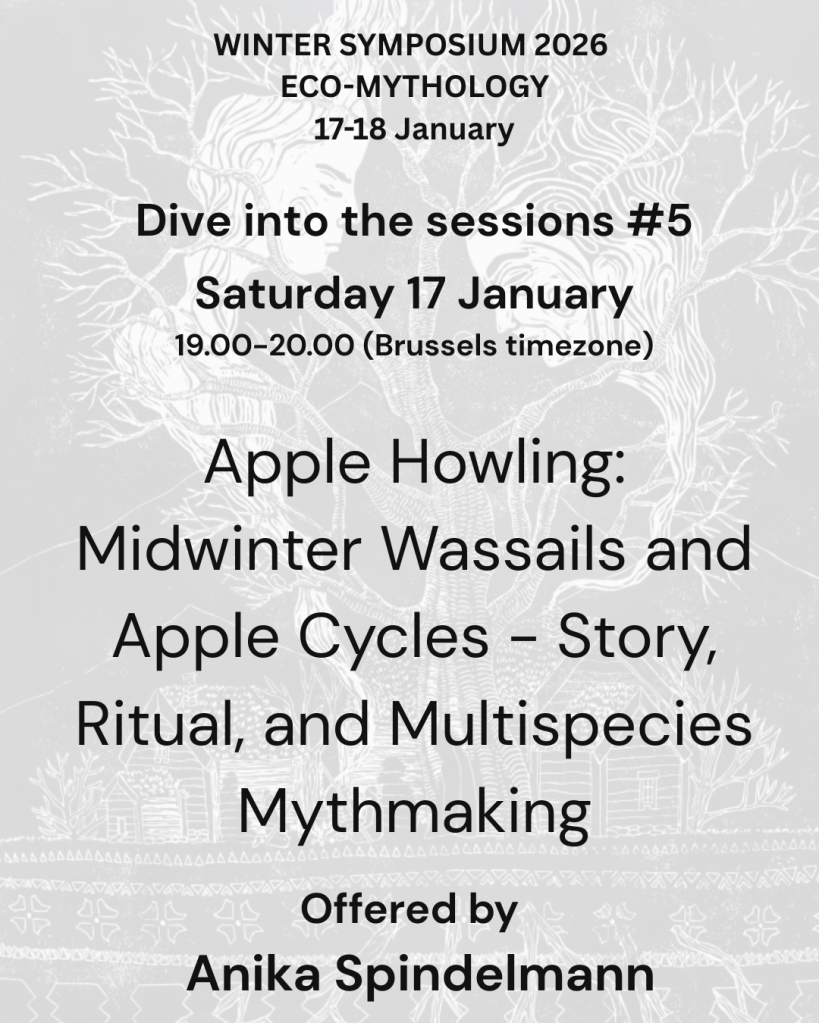
19.00-20.00: Apple Howling: Midwinter Wassails and Apple Cycles – Story, Ritual, and Multispecies Mythmaking – Offered by Anika Spindelmann
This session explores the intersections of folklore, reciprocal care, and multispecies mythmaking through story, poetry, and participatory ritual. It asks whether old customs can become portals for reweaving kinship between humans and the more-than-human world. Mid-January traditionally marks the season of wassails: midwinter rituals of awakening and blessing orchards through song, offerings, and communal gratitude. Rooted in English folklore, wassailing (or “apple howling”) was a collective act of calling in a fertile harvest. This session offers a contemporary reimagining of that ritual as both ecological practice and mythic inquiry.
The session starts with a Reading of the poem In Apple Cycles, which traces the seasonal life of apple trees and a local micro-orchard wassail, we’ll weave story, myth, and ritual to consider how such traditions might guide us in relating differently to land, trees, and one another.
There will be a brief talk on the history and contemporary reimagining of wassailing, before Anika invites you on a participatory wassail ritual, including writing chants
As we move through the ritual, we will reflect on how reclaiming seasonal customs can open pathways into multispecies mythmaking and help cultivate reciprocal relationships within damaged ecologies.
Inspired by Sophie Strand’s vision of myth as “a patch of soil” where care and story can take root, and by Isabelle Stengers’s “ecology of practices,” we will consider ritual and storytelling as grounded, place-based ways of knowing. In the Plantationocene, a term from Haraway and Tsing describing entwined systems of extraction and ecological loss, the orchard becomes both a managed landscape and a site of possibility. Can micro-orchards become small laboratories for new mythmaking and renewed kinship?
short descriptions of each session – SUNDAY 18 JANUARY
09.00-09.30: Welcome – Offered by Vitalija Povilaityte-Petri (coordinator)
In this 30-minute welcome session, Vitalja, one of the study circle coordinators, will open the second day. She will explain the Miro board, our shared “cauldron”, and stir it a bit more, adding some questions.
09.30-10.30: Keynote by Rick Dolphijn and/or Irena Chawrilska (to be confirmed)
This session will be recorded and downloaded on our private Youtube after the session. The URL will be added in the MiroBoard (cauldron), so the people from especially UK and East Coast can listen to this later in the weekend.
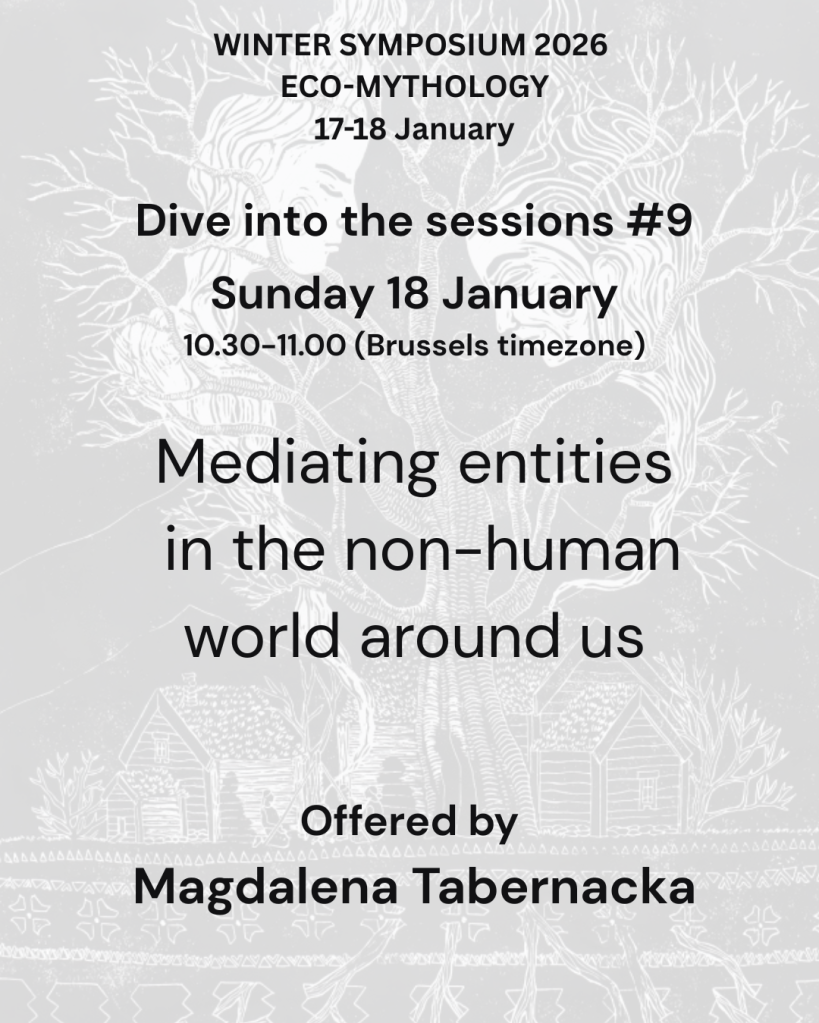
10.30-11.00: Mediating entities in the non-human world around us – Offered by Magdalena Tabernacka
Magda will read a story, which is inspired by an article by Professor Ludwik Stomma, a cultural anthropologist who wrote about intermediate entities in the natural and cultural world, for example, the Południce (Southlings), mythical beings said to live along field margins, or even ticks. His work explores what constitutes a transitional entity between two states (such as life and death) and how such entities affect people. The participants will be invited to draw their “own mediation”, something that exists between us or around us, and later share it with one another, in the cauldron. This is entirely optional, as some drawings may be very personal.
11.00-12.00: Photovoice invitation
We like to challenge the idea of indoorsy symposium where participants stay inside for the whole day. Every day we reserve some time to go outdoors, so all participants have time to get enough vitamin D and also try out a method for story/data collection. All participants are invited to go outdoors.

This is an invitation, not an order. You can also use this time for something else. We believe that you know what is best for you. The zoom session will be open and Vitalija will be the guardian, for all who have questions or need assistance with the cauldron.
12.00-13.00: Lunch break
The zoom session will be open and Wendy will be the guardian, for all who have questions or need assistance with the cauldron.
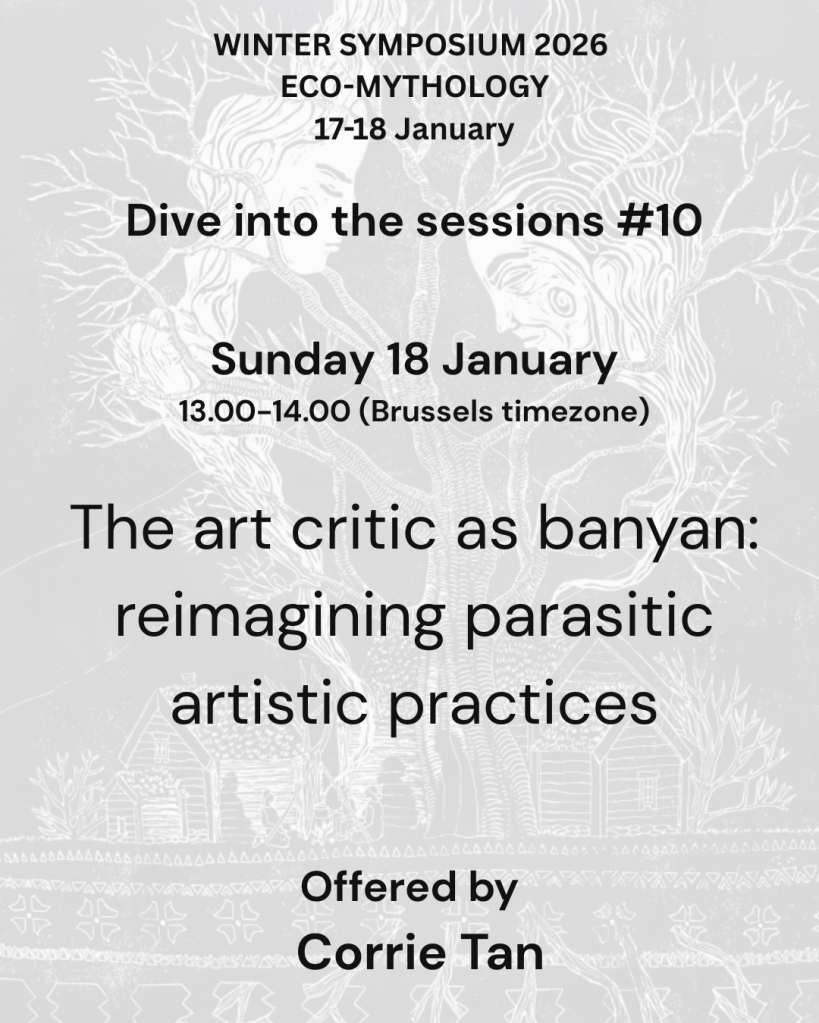
13.00-14.00: The art critic as banyan: reimagining parasitic artistic practices – Offered by Corrie Tan
The banyan is a strangler fig that germinates and grows on another plant, eventually enveloping and consuming the host tree on which it was born. The tree features prominently across Southeast Asian religions, mythologies and symbolisms, and is most recognisable by its massive and dense aerial root system. In many cases, the banyan that outlives its host also offers a sheltering space to other creatures in its hollow central core.
Where the host tree was once hospitable to the banyan, now the banyan has established a new relationship of hospitality to its host and other more-than-human beings in its ecosystem. Like the spectacularity and durability of the banyan, the text of performance criticism might eclipse the brevity and ephemerality of performance. This is both a space of provocation and possibility. The banyan also offers shelter to the host tree it swaddles, shielding it from the elements, and leaving a more rigorous structure of support as it grows.
This sharing offers participants from the Nordic/Baltic archipelago a correlating eco-mythology from an archipelago halfway across the planet: maritime Southeast Asia. Drawing from the banyan, what are our practices of Intertwining, Embracing, Swaddling, Sheltering, Encircling?
14.00-15.00: Stirring the cauldron
We know how energy-draining a Zoom session can be, so we have planned longer breaks. During these breaks, your time to stir the cauldron, you are invited to add questions, comments, feedback for the presenters, photographs, or any other “ingredients.” You can also use the time to do something else, write, or process your reflections. The zoom session will be open and Wendy will be the guardian, for all who have questions or need assistance with the cauldron.
15.00-15.30: Discussion about Photovoice – Offered by Vitalija Povilaityte-Petri (coordinator)
Vitalija will facilitate a talk about photovoice and if/how this method can create eco-mythology. There might be questions about what is medicine, what is poison, diagnosis and treatment.
15.30-15.40: Short intro of the summer symposium in Latvia – Offered by Wendy Wuyts (coordinator)
This includes an announcement of theme and call for papers, practices and poetry. As the winter symposium is seen as some sort of preparation of the week-long summer symposium, where all the study circles gather together for a week in a physical location in the Nordic-Baltic region, we invited a local academic to give us some insights about the host country in 2026.
15.40-16.20: Eco-mythology and transformative practices with/in the more than human Latvia – Offered by Kārlis Lakševics
The session will highlight inspiring Latvian and Baltic artists, researchers, and initiatives working at the intersection of ecology, cultural heritage, and multispecies futures. These may include practitioners of bioart, forest ethnography, environmental humanities, and community-based ecological storytelling.
Kārlis will also offer recommendations for activities participants can pursue while in Latvia this summer for the fourth symposium of this NSU study circle: places to meet the more-than-human world through slow walking, forest bathing, bog exploration, traditional craft encounters, and visits to ecological or art-research sites that model relational practices with land, waters, and other beings. He will share a brief overview of his own past, current, and future research.
16.30-17.30: Dreaming an ecomythology for the Nordic-Baltic region
Offered by Wendy Wuyts (coordinator)This one-hour closing session begins with collectively looking into the cauldron. We will experiment with shared-line poetry or another technique designed to generate many rich questions without trying to solve them. Together, we will practise peering into the cauldron and engaging in a group process of question-generation. For 30 minutes, we will try to create questions that help us imagine, and begin to live, new dreamscapes and rich questions for geo-ecomythology. We will also consider which spaces and places we might want to visit next. The final 30 minutes will be a sharing circle, where we reflect on what is in our “medicine” or “carrier” bag and what we will bring forward. We will close with expressions of gratitude.
FAQ
Will there be recordings? No, we will only record and publish the morning sessions (keynotes), for the people from the west of Europe and the East coast of North-America to catch up later in the day, but as we plan to make this online symposium interactive, we limit the recording.
Will there be free reports or other outputs that we can consult later? Yes, some outputs will be blogposts on this website in the spring of 2026.
Keep an eye on this page: NSU circle: Learning with the More-than-human where you can find a lost of blogposts. We recommend to subscribe to the newsletter for some more free outcomes and announcements of next symposia in 2026 and 2027.
There is also an Instagram account where we focus on mythic imagination with/for the Baltic Sea. I spent some hours on making and scheduling 30 Instagram carousels that will gently introduce and prepare you for this winter symposium. But no worry, if you do not have Instagram, you do not have to worry out that you miss on essential information.
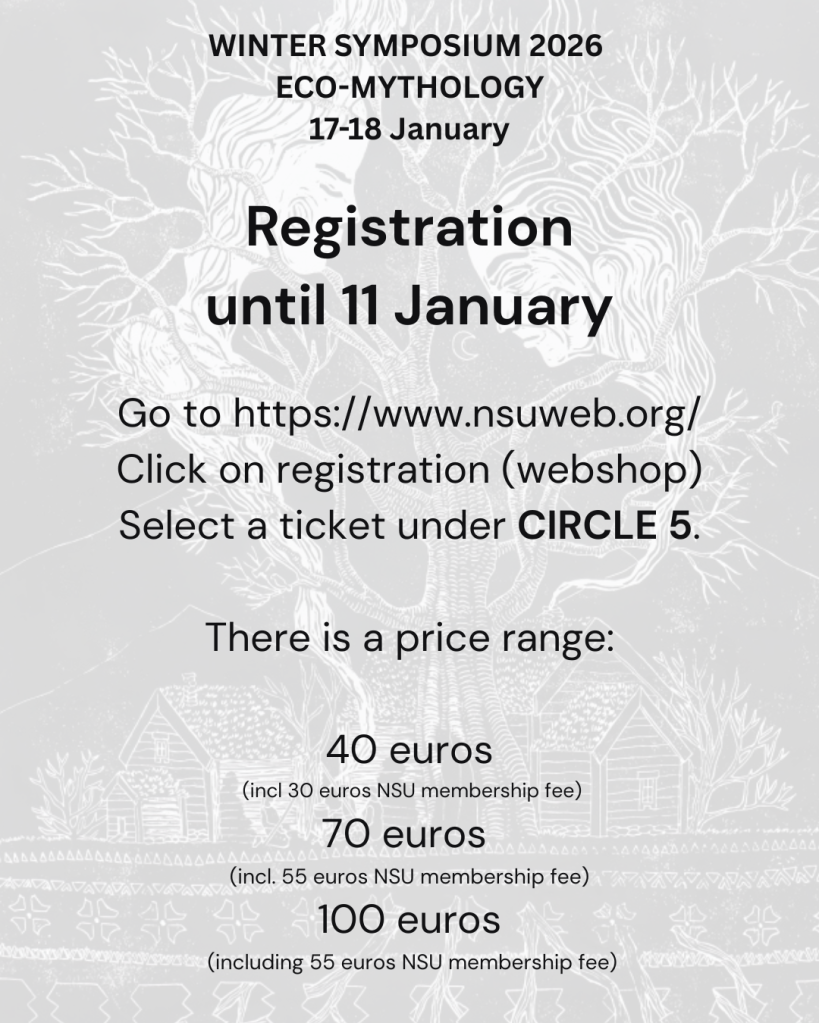
Is there a price? We work with a price range. The lowest price is 40 euros, this is for students and other people without a big income. If you have an income, but it is still low, do not feel shy to take the cheapest ticket. If you have a decent income, we ask you to pay 70 euros, or even 100 euros, if you want to support the objective of our study circle: promoting and co-researching transformative (un)learning practices with/in the more than human world.
What is included in the price? The price envelops membership fee to the Nordic Summer University (NSU). This helps this democratic institute to pay for website and other administrative costs. This means that you will get a discount of 30 or 55 euros to the physical week-long summer symposium in Latvia (24 July – 01 August). The rest is for paying some costs of the coordinators, who are working as volunteers in 2025-2027 for NSU, including the zoom and MiroBoard subscription. You will also get a PDF of a book chapter written by the coordinators. All the participants (presenters and listeners) will get free access to the network, the MiroBoard (in January-February) and the recordings of the morning sessions.
I am in. How can I register?
You can register only by paying a ticket in the NSU webshop. It is important that you pay a ticket for study circle 5.
- https://www.nsuweb.org/shop/
- You add a circle 5 ticket to the basket by clicking on the dark button. (40 /70/100 euros)
- Then ‘view basket’ appears under the button.
- You will enter a new page which displays what you registered.
- You proceed to check out and pay.
- (It will ask dietary requirements, but you can write down NA (Non Applicable))
Registration is until Sunday 11 January (midnight). On Monday January 12th, we send out an email with a zoom and MiroBoard link.
Discover more from Stories from the Wood Wide Web
Subscribe to get the latest posts sent to your email.
 Stories from the Wood Wide Web