I’ve recently developed a new fascination: magical realism as a genre to understand the depths of other places. I’m captivated by the way authors create new folklore, or weave existing folklore into their stories, and anchor it deeply in a particular place.
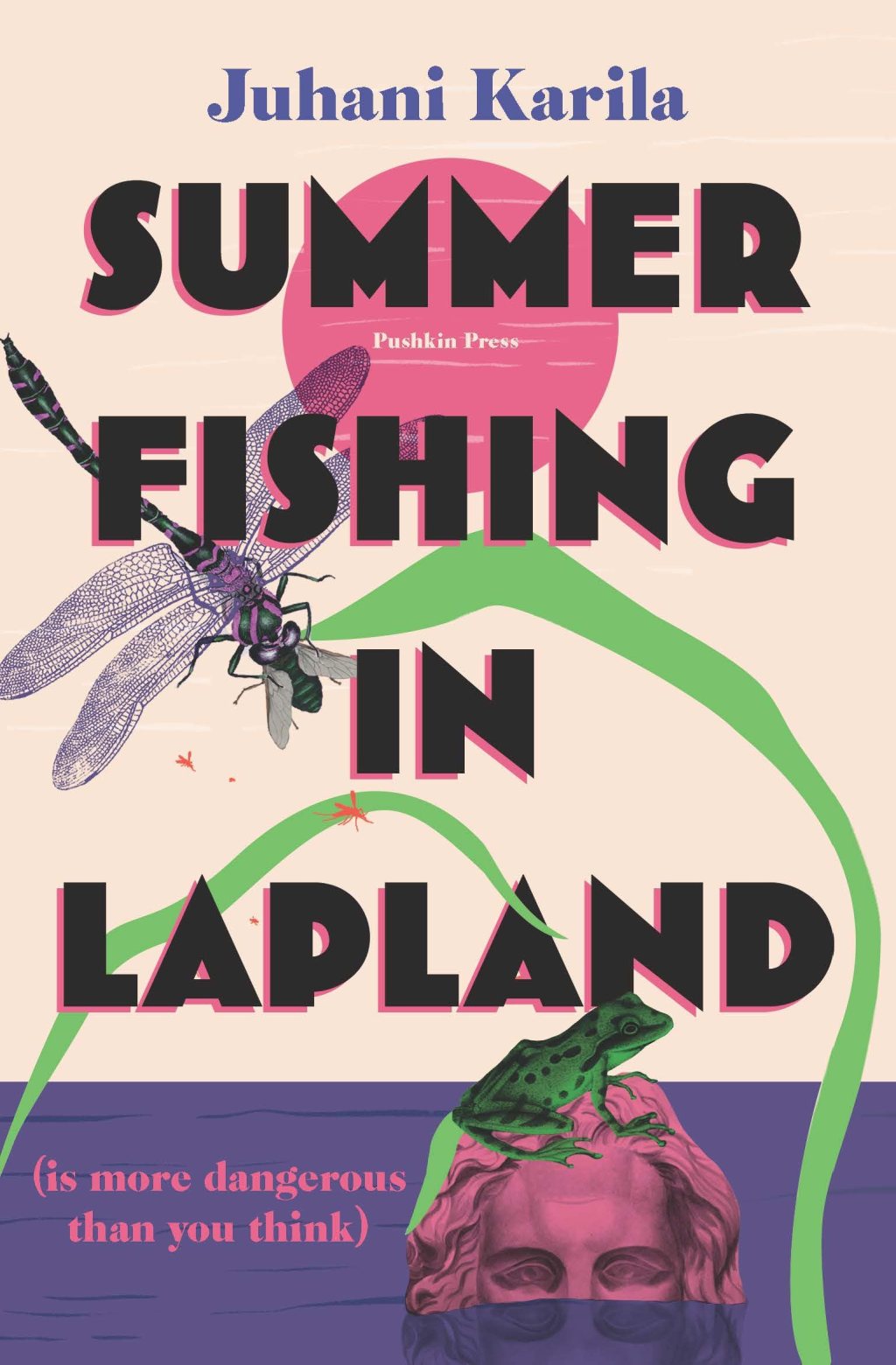
That’s why I was so intrigued when I came across the book Summer Fishing in Lapland. The bookseller described it as magical realism, and I was immediately excited. I read it… and I loved it. It has become one of my favorite novels in recent years, standing alongside the works of Elif Shafak, Katherine Arden and Andrus Kivirähk.
Summer Fishing in Lapland is an ecophilosophical fantasy that invites readers into a world that feels at once real and enchanted. Originally published in Finnish as Pienen hauen pyydystys, this is Juhani Karila’s debut novel. It has been translated into seven languages and has received three national awards: the Kalevi Jäntti Prize, the Jarkko Laine Literature Prize, and the Tähtifantasia Award, an annual prize presented by the Helsinki Science Fiction Society (Nykänen, 2024).
Under-the-skin Humor
As a Belgian, I’ve been trained in sarcasm and irony from an early age. Our humor tends to be darker and sharper than British humor. A Norwegian journalist once told me he had always considered British humor to be sharp and sarcastic… until he encountered Belgian humor. Ours is so dry and cutting that people sometimes don’t even realize I’m being sarcastic. This often leads to misunderstandings, with others only realizing later that perhaps I shouldn’t have deployed my Belgian humor in that moment.
This summer, for example, during democratic sessions at the Nordic Summer University, a Dutch participant (from near the Belgian border) was chairing. I seemed to be the only one laughing at her witty remarks. That contrast made me realize again how humor travels… or doesn’t.
People have remarked that my humor, especially in my writing, often comes from “under the skin.” I gravitate toward satire, and one novel I particularly enjoyed was The Man Who Spoke Snakish by Estonian author Andrus Kivirähk. It’s deliciously weird (some would call it absurd, but I appreciated its sharp, under-the-skin humor and its parody elements. While some readers might dismiss it as superficial, I believe they miss the deeper, bog-layered themes: the clash of ideologies around control and coexistence with the more-than-human world, as well as questions of responsibility and resilience.
A love story that turns sour
Elina, the protagonist, makes her annual summer pilgrimage to her family’s remote farm in Lapland. She has just three days to catch a pike in the Black Pond. Otherwise, both she and the man she loves will die.
The love story itself only emerges gradually, told in fragments. Yet I hesitate to call him the “love of her life,” because it quickly becomes clear they were never truly a match. Their worldviews were irreconcilable. (In fact, they once had to write a school essay about themselves and the world, which neatly captures their divide.)
Elina embodies a worldview that allows life to overgrow, tangled and coexisting. He, by contrast, represents the drive to overbuild, to conquer, to always be right, constantly seeking justifications. What struck me is how the first worldview is carried by a woman who internalizes guilt and shame, as if she is the one who is wrong, while the second belongs to a man, a so-called artist, whose ego and choices she supports. She is the one who yields, who enables his career, his art, his life.
It’s a dynamic that invites an ecofeminist reading: the woman aligned with the overgrown, the vulnerable, the self-doubting; the man with the dominating, the self-justifying, the consuming.
Gendered finnish concept of sisu
I came across an academic review of the novel by Finnish lecturer Nykänen (2024), who links the book to the Finnish cultural construct of sisu. Sisu can be understood as both a mental and bodily capacity to endure and act in the face of extreme adversity. It’s not inherently positive or negative. On the one hand, it encompasses perseverance, patience, diligence, tenacity, and courage, qualities that have been celebrated in Finnishness since the 16th century. On the other hand, it carries the risk of tipping into hyperindividualism or feeding a culture of self-help and stoicism.
Traditionally, Finnish literature has depicted male characters as embodiments of sisu: wild men of the forest, simple country folk, stubborn beyond reason. Nykänen points out that it is an intriguing choice for Karila, a male author, to assign sisu instead to two female characters and even to the more-than-human world. He suggests this twist functions as a parody of sisu, reframing and poking fun at the cultural trope while also broadening its meaning.
Pokémon
As a child, I was a big fan of Pokémon, and part of what drew me into Summer Fishing in Lapland was how its world felt a bit like a Pokémon universe. Human characters interact with folklore-inspired beings, without endless questions about cohabitation. Instead, you simply accept an unknown ecology unfolding in the restricted area of Eastern Lapland: knackies (näkki), raskels (peijooni), straipefoots (raitajalka), fetchers (para), writhes (hattara), frakuses (meteli), pixies (keijunen), frost fairies (hyyryläinen), demons (hittolainen), and many other nonhuman agents that populate this landscape.
Karila, the author, stands out as one of the Finnish contemporary authors who creatively adapts and reimagines Lapland mythology and Finno-Ugrian folklore. His world-building estranges readers from their habitual notions of perception and belonging. Summer Fishing in Lapland belongs to the hybrid genre often called Finnish Weird (suomi-kumma): a blend of fantasy, science fiction, and realism, where magical elements are gradually introduced into an otherwise realistic setting. It also echoes Nordic noir, which often mixes crime and atmosphere with existential weight.
Mythology enriches this further. In Finno-Karelian tradition, the pike itself is a shaman’s spirit-helper, dwelling in the netherworld (alinen) and ferrying the sick to Tuonela, the land of the dead. The pike carries a dual role: source of both sickness and life-giving fire. In the novel, the Black Pond becomes more than just a setting, it is a portal, a “dark opening” into another dimension, mirroring the imaginary border of Eastern Lapland that marks an entrance into a wilderness where the Finno-Ugrian notion of the nonhuman, as beings with souls, still lingers.
Rational south vs emotional north
Nykänen’s analysis highlights a symbolic contrast: the tamed South versus the wild North, the rational South versus the emotional North. It reveals much about how the Nordic imagination positions itself in relation to the world. This resonates with reflections that emerged when I wrote a funding application some weeks ago and I had interesting exchanges with a Finnish forest bathing guide on the concept of “Northness,” exploring ideas from Pohjala in Finnish mythology to Rudolf Steiner and other imaginations of the northern realm. I also have observed this contrast in Norway: the rational South with Oslo and then the so-called wild northern realm. I believe this contrast is also interesting… from an ecofeminist perspective.
Let’s hope that we get the funding application… where we will explore even more what the real wild North means… to us all.
Bibliography
- Karila, Juhani. “Summer Fishing in Lapland”, Trans. Lola Rogers, London, Pushkin Press (2023)
- Keinonen, Heidi. “From a Literary Genre to a Television Genre. The Circulation of “Finnish weird”.” Series-International Journal of TV Serial Narratives 8, no. 1 (2022): 45-54.
- Nykänen, Elise. “From Solitary Quests to New Folklore. Reading Juhani Karila’s Summer Fishing in Lapland through Cultural Emotions.” Nordiques 46 (2024).
Discover more from Stories from the Wood Wide Web
Subscribe to get the latest posts sent to your email.
 Stories from the Wood Wide Web