During the 2025 Summer Symposium of the Nordic Summer University in Finland, our study circle on the ecology of transformative learning practices with/in a more-than-human world explored the overarching theme of economy, woven through our sessions, practices, and workshops.
I hosted a short session on reimagining economies through a poem about practices of reciprocal care between place, humans, and more-than-humans – as a portal to transformative learning and a (possible) shift toward post-anthropocentrism. The 30-minute session invited the group to sense, listen, and share, using In Appley Cycles – Practicing Reciprocal Care and Commoning in the Collective Micro-Orchard as our starting point. This poem traces a year in a suburban Danish micro-orchard, following the apple trees and their human and more-than-human companions cultivating reciprocal care, deep noticing, and entangled living.
When ‘other humans’ are adding their ingredients to the living art
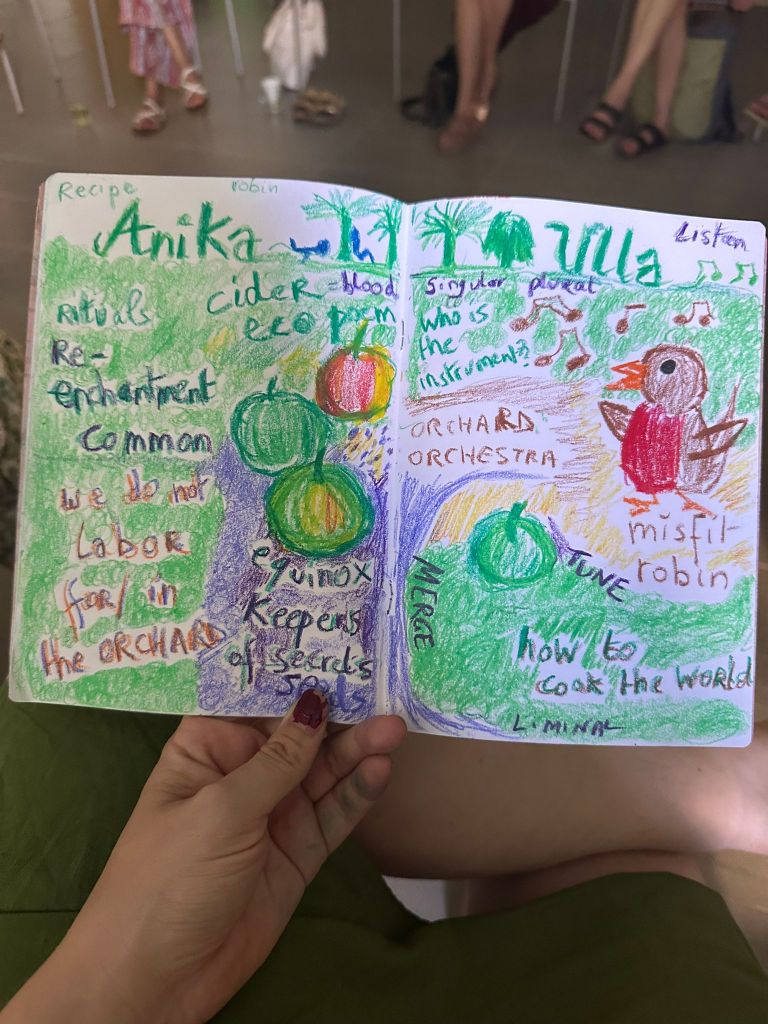
While the participants were sniffing and sipping on a local plant infusion, I read the poem out loud. Afterward, I invited for some minutes of silence and to reflect on their own living spaces, whether rural or urban, and to imagine how seasonal attentiveness and reciprocal rituals might translate into their own ecosystems. What comes up when tapping into appley cycles and time? What can be practices of reciprocity?
Some wondered about the possibilities and challenges of practicing rituals and cultivating attentiveness while leading migratory lives, as is the reality for many academics with short cycles of residence. Others shared practices such as leaving “spirit plates” in gardens as offerings to the land’s more-than-human and spiritual beings.
Many seemed to have grown up with apples in one way or another and were touching memories on how they are freely given, yet they demand attention at a precise moment of harvest, along with the care of preparation. The conversation turned to how these cycles continue beyond human eyes – the ways apples are digested, ripened, and even “cooked” to perfection by the sun. Charles Malamoud’s Cooking the World and its discussion of Vedic ritual and cosmology was mentioned, where cooking is not merely about food, but about transforming the world itself: to cook is to act upon the world, making it livable, meaningful, and sacred. which raised the questions: in what ways might apple cycles (and other seasonal cycles) serve as mirrors for the transformations we can nurture?
A slow digestion of stories
Later, more personal stories of cultural heritage and place-based practices emerged in private conversations.
One participant shared that a relative had once served in the Soviet army and was stationed in Kazakhstan – the lands where apples first originated. The wild ancestor of the domestic apple still grows in the mountains there. This relative carried seeds home in his front chest pocket and planted them in his garden. From that act, a distinctive apple variety emerged, unlike any commonly found in Europe.
This, too, revealed how stories travel – through us, with us – and how they need time to be digested and fermented before their effects truly emerge.
Reflections on receprocity and gift economy
In our discussion, the concept of the gift economy, also mentioned by Robin Wall Kimmerer in The Serviceberry, also surfaced. Yet questions emerged around its complexities. Can a gift ever be entirely free of expectation? Does it risk slipping back into the logic of exchange, with a hidden demand for return?
A gift offered into the world without the guarantee, or even the need, of being reciprocated opens space for generosity without transaction. Reciprocity, then, may be less about keeping balance sheets even, and more about cultivating relationships of care where return is possible, but never enforced. Reciprocity, unlike transaction, can hold the asymmetries of time, place, and circumstance, honoring that sometimes we give as we have adubance to share in terms of resources, time, capacity etc., sometimes we receive, sometimes the earth herself holds the offering until it ripens into an unexpected form.
Further explorations and widening circles
Fermenting further – in Isabelle Stengers’ sense of reciprocal capture, how might we allow ourselves to be caught up in relationships that transform us, rather than ones we seek to control? Can we imagine ways of living where gifts, cycles, and transformations move through us, rather than belonging to us? And as the apples are ripe right now in the northern hemisphere – what can you learn from/ with apples, from the apple tree?
Discover more from Stories from the Wood Wide Web
Subscribe to get the latest posts sent to your email.
 Stories from the Wood Wide Web