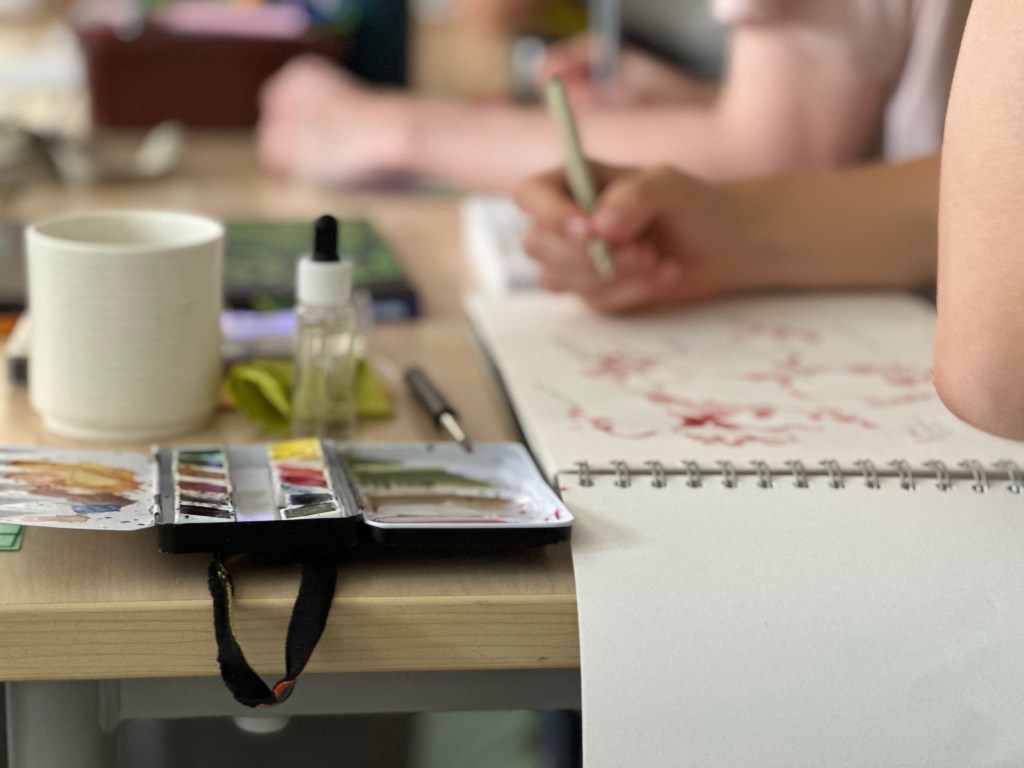
This blog post is linked to our study circle about learning with the more-than-human-world at the Nordic Summer University, specifically to the first summer symposium, which took place in Finland from 21 to 28 July 2025.
Photovoice as a method
At the start of our summer symposium, we used Photovoice, a participatory visual research method that combines photography and storytelling to empower individuals—especially those from marginalized communities—to share their experiences and advocate for change. Normally, participants capture their perspectives on a specific issue through photos or drawings, then reflect and discuss these images to create narratives that expressed their concerns and hopes.
At the beginning of our summer symposium, we asked participants to share it in the WhatsApp group, with a short caption. We had originally planned to do a second round at the end, followed by a reflective wrap-up process, but we ran out of time (our mistake for accepting too many offers, leaving no space to digest everything). Nevertheless, this blog post serves to document and archive some of what was shared, keeping it as a “fruit” in our carrier bag for the entire study circle period (2025–2027).
I tried to organize them under broader themes, such as adaptability, abundance, and care ethics.
ECONOMY = CARE OF LAND & PEOPLE
Let’s start with the photo shared by our indigenous wisdom keeper, which beautifully re-centers the concept of economy around its original meaning (from the Greek oikos nomos – the management of the household). Deep ecology, with its emphasis on intrinsic value of all life forms and interconnectedness, can bring several contributions to post-capitalist economics:
- Redefining Value Beyond Profit
- Interdependence instead of Extraction
- Long-term thinking
- healing as economic purpose

What contribution can deep ecology (learning from Nature) bring to post capitalist economics?
Is NSU the opportunity for economy of healing life rather than economy of profit 😔💗🙏🏿
resilience and adaptability under constraints

The plants’ behavior—leaning, hiding, and draping to avoid being cut—mirrors how economic agents or systems adjust strategies in response to limiting factors or external pressures.
Supportive infrastructure

The economic theme reflected in this text is ecosystem services or mutual interdependence within ecological systems. Specifically, it highlights how natural elements (juniper branches) provide resources and infrastructure (habitats and surfaces) that support other organisms (insects, spiders).

This aligns with economic concepts such as:
- Resource provision – natural structures serving as resources for other species.
- Supportive infrastructure – ecosystems creating the conditions for other economic or biological activities.
- Interconnectedness and externalities – illustrating how one element’s existence benefits others, similar to positive externalities in economics.
It could also be tied to themes like the gift economy or abundance, where nature freely provides benefits that sustain a network of relationships.

This photo explains how this supporting infrastructure or cooperation can serve as a foundation for value creation and well-being, where health is the real currency, and not euros or dollars.
the commons and collective benefit

The description challenges traditional economic notions of individual transactions and compensation, instead emphasizing:
- Economy as a shared system – where interactions benefit the whole ecosystem rather than individual entities.
- Gift economy – where contributions (like the birch hosting the lichen) occur without expectation of direct return, yet still support the larger system.
- Post-capitalist or ecological economics – recognizing that value lies in sustaining life rather than in measurable exchanges.
- Interdependence without freeriders – reframing “costs” and “benefits” as part of a holistic logic that serves Life itself.

How can our economy be more feminist?
If we held what we got freely from the planet with more respect like the dew in the morning, and were slower in our actions, what would change?
If we had a visual indicator for economic health connected to not finance, but environmental/planetary impact and symbiosis indicator/regeneration, would it change the way we do things, as much impact can be initially invisible and easy to overlook….

🌿 NSU as an Opportunity
NSU can be a living example of an economy that serves Life: a space for experimenting, sharing, and planting seeds of a healing future.

Even at the start of our summer circle, it was clear that we already know many of the answers, solutions, and pathways forward. The real question might be why we are not acting on them. Perhaps it is about asking better questions, creating spaces where more people engage in critical rethinking, and digging deeper. Another round of Photovoice with the same prompt may not have been necessary, as it would likely have repeated what was already expressed.
A key lesson may be to focus more on the how—how we can dismantle what no longer serves us while also protecting our mental health. For me, the most profound learning of that week came from an unexpected place: the public sauna. I will write a blogpost about this, because the whole experience let me remember that re-enchantment is both a spiritual and political act. It is not merely about whimsy; it is also about coping with pain bodies and supporting mental health.
That is why I suggested to my fellow coordinators that the theme for our next summer symposium could be mental health. What can we learn from the more-than-human world about promoting mental health while entangled in this toxic mess—or, to borrow Michael Marder’s term, this dump?
Discover more from Stories from the Wood Wide Web
Subscribe to get the latest posts sent to your email.
 Stories from the Wood Wide Web