In spring 2025, I assisted a team in preparing a proposal for one of the two Slow Pavilions at the first Copenhagen Architecture Biennial (September 18th to October 19th). The theme, Slow Down, explores architecture as a matter of time and as a means to slow down overheated sites, cities, and societies. I developed an initial draft of the pavilion’s eco-mythology. Although our proposal was not selected (one of my startup colleagues won, which was wonderful), I would still like to share the poster I created during the process:
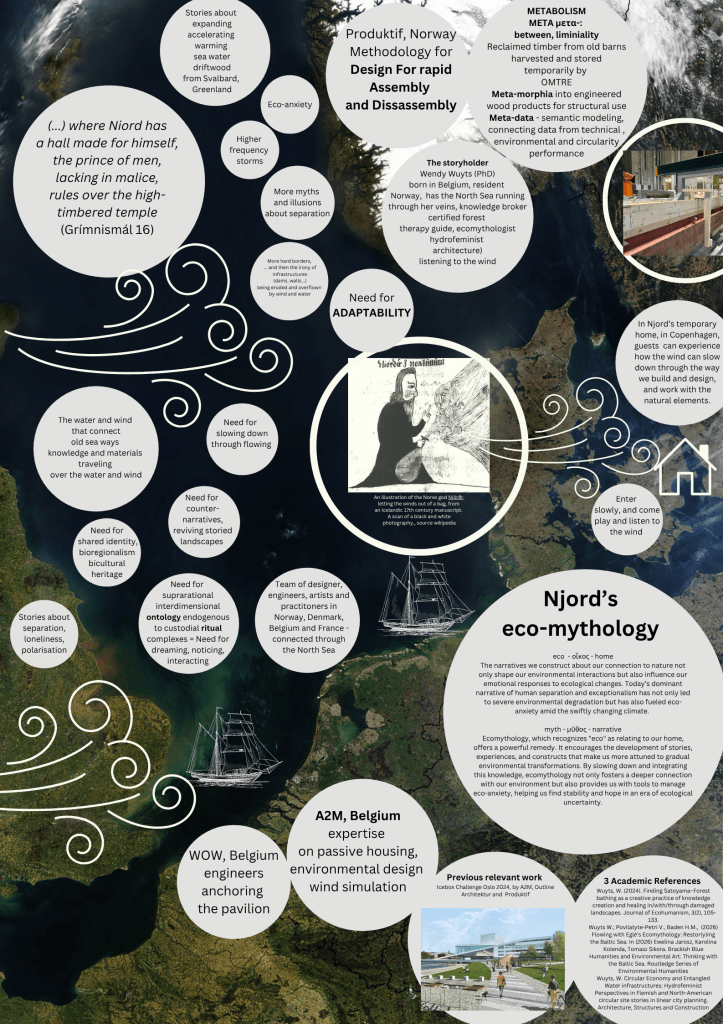
Some notes:
Working with the wind and njørd
One of our departure points for the pavilion design was to work with the wind—to use its natural cooling power to refresh the site. We explored how wind directions and flows could be harnessed, even running simulations to see how altering the space might influence air movement. When the architects spoke about this interplay with the wind, I immediately thought of Njörðr, the Nordic god of the sea and wind.
Njörðr’s story, especially his marriage to the mountain goddess Skaði, has always fascinated me. Their union ended in what might be described as a joyful divine divorce: despite their love, neither could feel at home in the other’s realm—he longed for the seashore, while she missed the mountains. This tale is not only about incompatibility but also about the deep sense of belonging that different beings have to their specific environments.
This story resonates deeply with the pavilion’s theme. It reminds us that home—or oikos, the root of the word ecology and economy—is about relationships with place. Just as Njörðr thrives where the wind and sea meet, architecture can learn to work with, rather than against, the elements. By honoring the wind, we honor the environment as a co-creator in shaping spaces that invite cooling, slowing down, and rethinking our relationship with the world.
circular economy, metabolism and re-enchantment
Another fascinating word is metabolism, especially when we trace it back to its Greek origin, meaning “change” or “transformation.” The term has reemerged in discussions around the circular economy, particularly in urban and socio-economic metabolic studies, which analyze how cities and societies consume, transform, and circulate resources. I have a personal connection to this concept, having published several critical academic papers on the topic.
The pavilion design embodies these ideas by applying circular economy principles. It uses reclaimed timber from our startup, connectors with a high detachability score, and embraces temporality—acknowledging that structures, like ecosystems, evolve and eventually return to the cycle of materials.
For me, eco-mythology is not just storytelling; it is also a way to re-enchant the world. Through narratives and conscious design, we can shift our relationship with the environment. By working with the more-than-human world—such as harnessing the wind—and addressing pressing issues like the urban heat island effect, we create spaces that are not only functional but also alive with meaning. In this way, design becomes both a practical and poetic act, weaving together science, myth, and care for our planet.
Contact me for a collaboration in 2026
From January 2026, I will be open for collaborations with architects, designers and engineers to create eco-mythologies and designs adapted to the local needs and resources.
Discover more from Stories from the Wood Wide Web
Subscribe to get the latest posts sent to your email.
 Stories from the Wood Wide Web