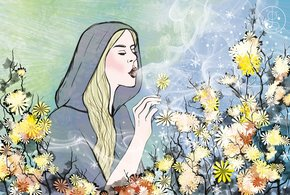
One of my ongoing projects is exploring stories of the divine feminine in Europe, often hidden within the veils of local folklore, mythology, and the lives of saints. My journey takes me to the edges of Europe—Scandinavia, Ireland, the Baltics, and the Balkans—and to local female saints whose legends may have roots in pre-Christian goddesses. It’s a process guided as much by intuition as research.
Two figures that have recently captivated my attention are Kalte Sophie (or “Cold Sophie”) and the Cailleagh, both connected to the season’s final frosts and the cycle of winter into spring. Their stories hint at an ancient wisdom, a caution about nature’s lingering grip…
The Ice Saints and Kalte Sophie
In many Catholic countries, the Ice Saints—St. Mamertus, St. Pancras, St. Servatius, and St. Boniface—are commemorated between May 11 and May 14, followed by St. Sophia of Rome on May 15. Farmers and gardeners historically observed this period, waiting to plant crops until after these dates to avoid late frosts that could ruin their harvests. In southern Germany, this tradition still endures.

St. Sophia, known in Dutch as Koude Sophie and in German as Kalte Sophie, seems tied to this seasonal caution. But her story, unlike those of the other Ice Saints, leaves gaps. Could she have replaced a goddess of old, one who presided over the last, stubborn frost of spring? The name Sophie, meaning wisdom, offers a potential clue, but no clear mythological parallel emerges from her hagiography.
The Blackthorn Winter and the Cailleagh
Across the North Sea, a different legend echoes the same seasonal wisdom. The blackthorn winter, a term from rural England, describes a brief return of colder weather during spring, often coinciding with the blooming of blackthorn.
This cold snap is linked to the Cailleagh, an ancient goddess of winter in Celtic mythology. Traditionally, she holds sway over winter until Brigid, the goddess of spring, takes her place (mostly in Beltane, 30 April, some days before the Ice Saints are celebrated).

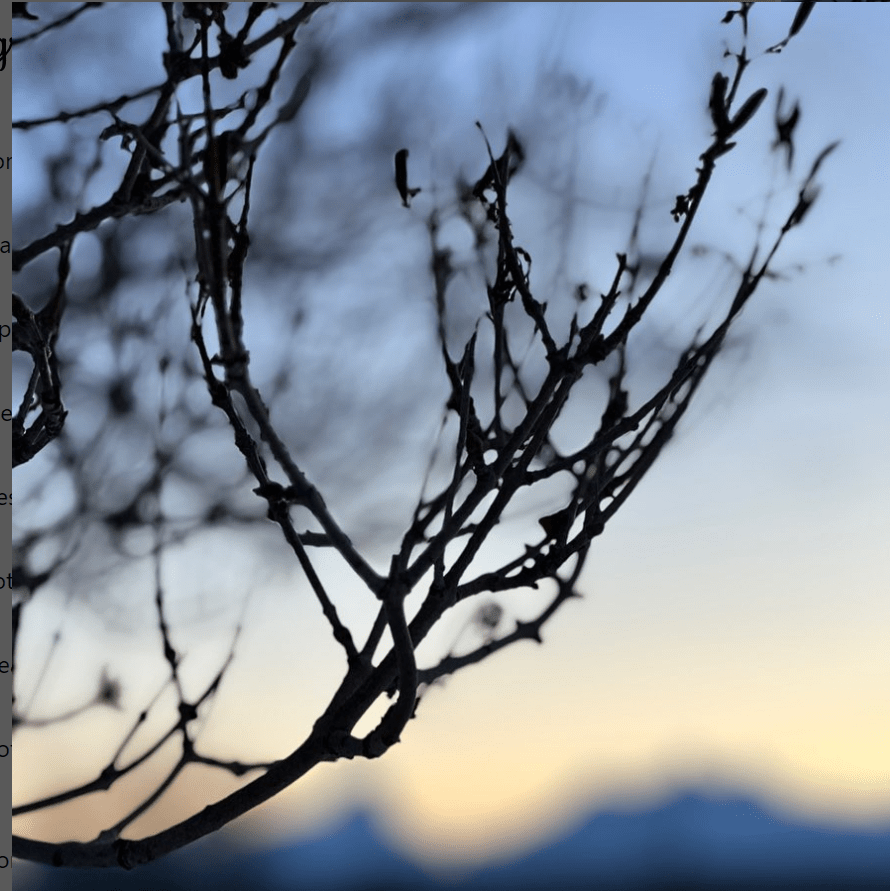
The blackthorn, with its stark and thorny beauty, seems like an emblem of the Cailleagh’s lingering presence in the season. The alignment of May’s frosts with her mythology suggests that her “final hand” might manifest in these last cold nights, as if she is reluctant to release her hold on the land.
Skadi, the Frost Giants, and the Mysteries of Frost
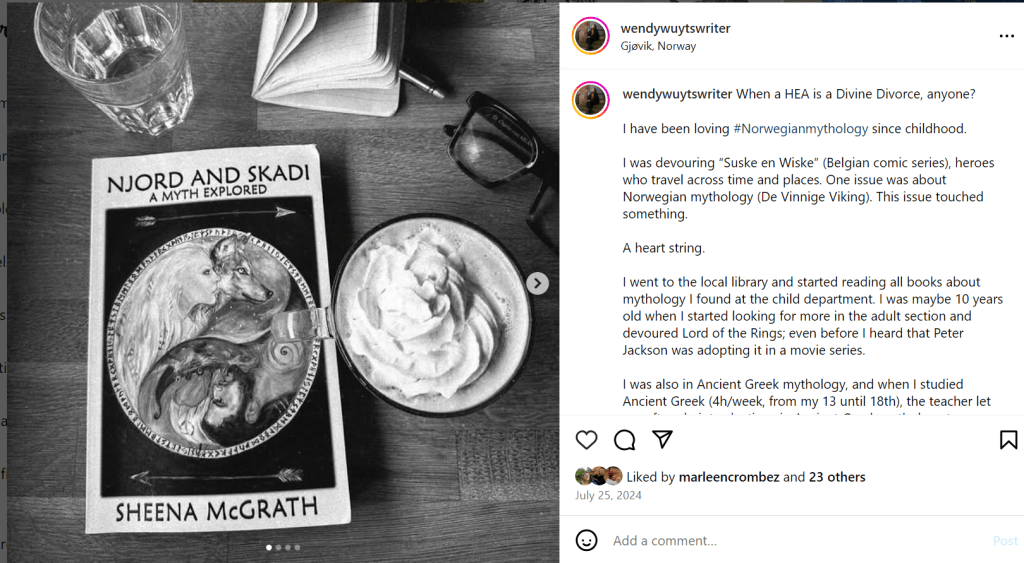
In my work, I’ve begun drawing connections between the Ice Saints and Skadi, the Norse goddess of winter and mountains, who is sometimes described as a frost giant. Skadi embodies strength, independence, and a longing for home—qualities that resonate deeply with me since moving to Norway, where I live among mountains and snow for much of the year.
Skadi’s mythological ties to frost offer another thread in my exploration of the Ice Saints. Could her association with frost giants, descendants of the primordial being Ymir, offer a metaphorical key?
In my 15 year-long creative project based on the retelling of the Persephone-Demeter myth (Only in Dutch, de witte droom – de zwarte kou), these frost giants hold the power to halt a devastating “Ragnarök of bloodthirsty plants” with their icy influence. Yet, I’m torn between seeing Skadi or the Cailleagh as the embodiment of this fifth, frost-related power.
Wisdom of Blackthorn Winter: Sophie and the Divine Feminine
As I reflect on these stories, I’m struck by how the threads intertwine: the cautionary tales of late frost, the blackthorn’s warning, and the longing for wisdom embodied by figures like Sophie. My background in Ancient Greek studies and a recent pilgrimage inspired by Hildegard von Bingen’s mystical writings lead me to wonder whether Sophie’s name—meaning “wisdom”—points to something deeper.
Or maybe working with Sophie’s name has only a dead end, and the only wisdom is just to be cautious for weather patterns. What do you think?
Do you want to learn more?
Sign up to a newsletter to receive blogposts and/or online workshops about Rewilding (female) saints. As you can see, a blogpost is written once a year, so this will be a very slow newsletter.
You can sign up via this link or by scanning this QR code:

Discover more from Stories from the Wood Wide Web
Subscribe to get the latest posts sent to your email.
 Stories from the Wood Wide Web