In this blogpost, I share background, recommendations for DIWO sessions, and (screenshots of) slides that I have been using in the 15 online writing(with)plant sessions ... that we have been organizing since November 2021 and sprouted from older projects (Re)*Rooting Circles and Brussels Health Gardens.
This blog envelopes the invitation to organize your own writing(with)plant sessions or to join the online circles that we organize. I announce the next circles on my Instagram profile wendywuytswriter.
Acknowledging vegetal intelligence
This practice is informed by the knowledge that plants are intelligent. Western science starts to acknowledge this, but in other, especially indigenous practices, they already know about plants as teachers, agents, medicine, allies and companions, for ages. We are all connected in a web of life and death. This practice is about becoming more open for vegetal intelligence and – in this way – for the intelligence of the whole ecosystem.
What is writing(with)plants?
It is a method, an experiment, a relational practice.
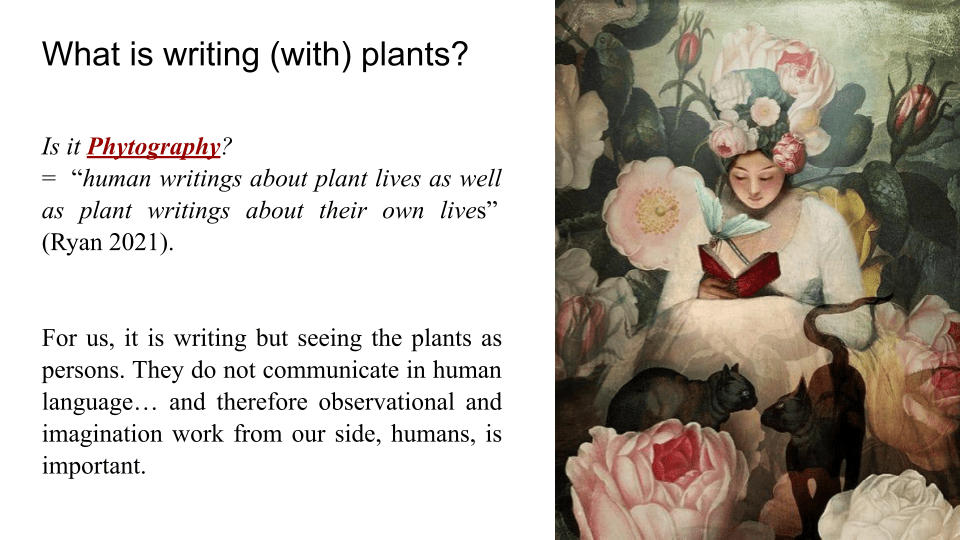
Different things can happen, but what we noticed in the 15 sessions, are the following interpretations:
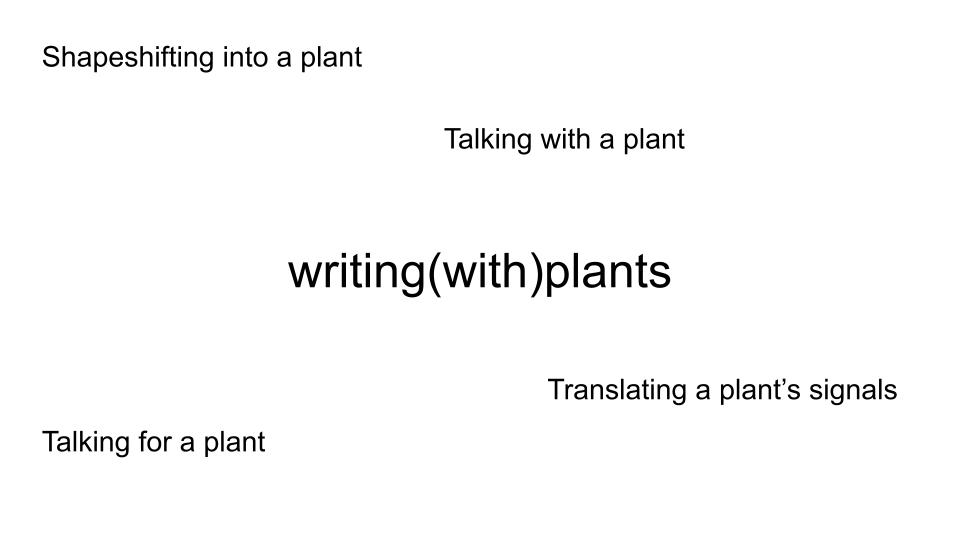
In the meantime, more than 60 people of more than 14 countries participated. Some joined once, others are recurring participants, and some others join a session, and then two years later, they show up again after skipping several sessions. Mostly, we have always 1-2 new faces, and we organized the slides in a way that newcomers can arrive, but that it is not too boring for recurring participants. The different themes, guest plant and group dynamics always bring something new.
The structure, process, roles and rules

I know that online (zoom) sessions can drain a lot of energy, so I honor everyone’s time, attention and energy and try to end the circle within two hours. In the beginning, I often ask people to share what they want to share, but to keep it simple and short.

The online sharing circle
In the session, there are 3-4 sharing circles. The number of sharing circles depends on the time management. I try to honor everyone’s time and keep the online session under 2 hours. That means I might skip one of the sharing circles to have enough time for the creative writing and arts practice at the end. This happens especially in circles with more than 10 participants.
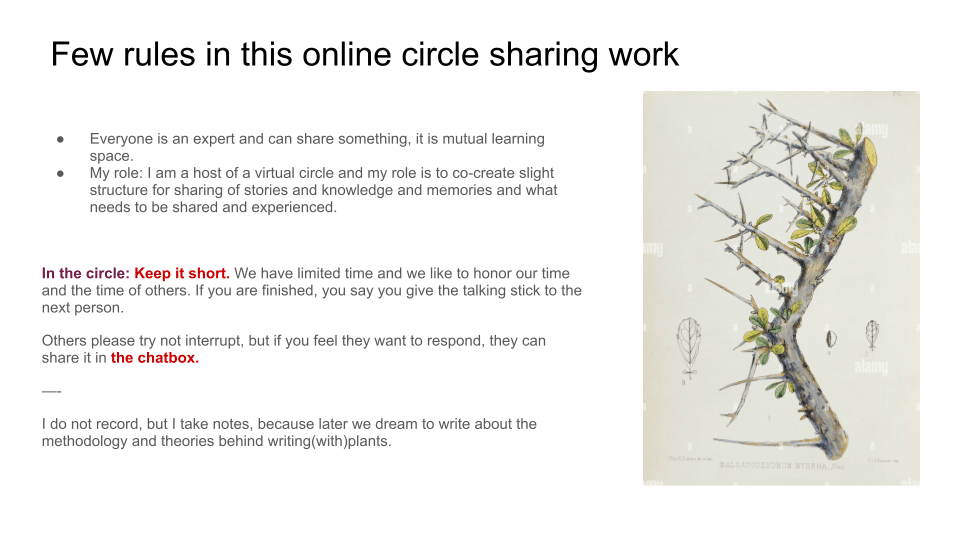
‘I give the talking stick to…’
The western society is full of speakers, but not listeners. How often have you been on meetings where people interrupted you?
I invite everyone to really listen. When someone hears and would like to react, they can write whatever they want to share in the chatbox, or wait until they got the talking stick.
As many people are not trained to know when the speaker finished, I ask the speaker to always end their talk with passing the imaginative talking stick to a next person.
Every workshop we had another guest plant:
- Holly
- Peonie
- Knotweed
- Hemp
- Night Blooming Jasmine
- Snowdrop
- Mistletoe
- Vanilla
- Dandelion
- Pumpkin
- Ginger and cinnamon
- Evening primrose
- Belladonna
- Yew tree
- Myrrh tree
After I introduced the guest plant, I organize a sharing circle where we ask everyone to share a fact, memory, association or so. I remind that they can also pass the talking stick if they do not know anything.

How do we select the guest plant?
Serendipity ;).
IN RELATIONAL PRACTICE, WE DO NOT LOOK AT THE GUEST PLANT IN AN ISOLATED WAY.
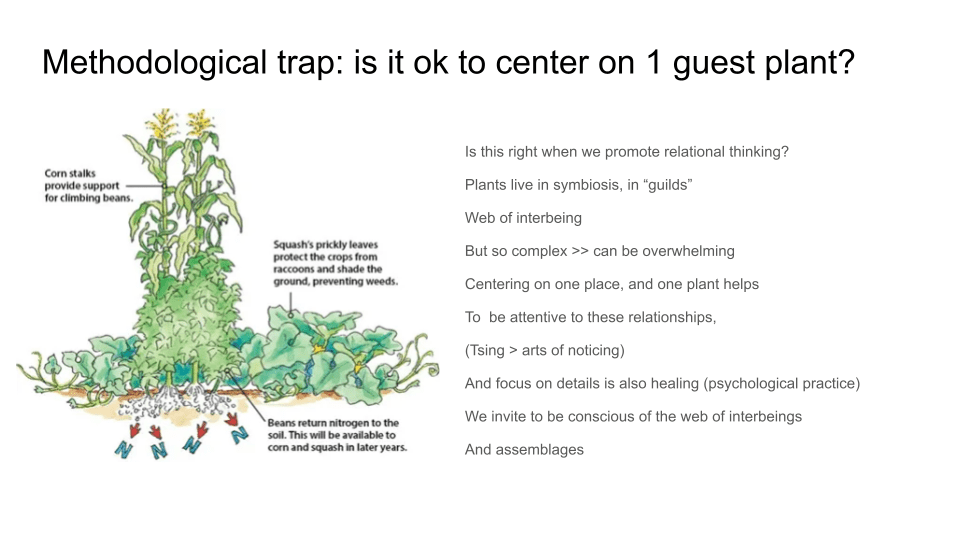
Once, we did an experiment and invited two guest plants at the same time: ginger and cinnamon. This experiment worked well. In other circles, we saw that also other plants got mentioned. For example, in the myrrh session, frankincense got called.
How do we select the theme beforehand?
I have to acknowledge the few partners in the background, like Vitalija Petri-Povilaityte, with whom I started this in 2021. She is my sidekick with whom I discuss themes and plants beforehand. In the meantime, there are recurring guests who also help in the background in the past year, by creating zoom session links. Mostly we look at associations of the guest plant and/or themes of the season. In the month November, when we need to slow down, we selected often poisonous plants and worked with themes around boundaries.
the creative writing and arts – or shapeshifting part at the end
This is the most imaginative part. I give them 15-30 minutes (depending how much time is left) to switch of their audio and video, perhaps listen music, and write something. I try to give them the freedom of expression and say it can in any language, or other format. I also say beforehand that they do not have to share it, but that the last part (afterwards) is a final sharing circle where they can show or read what they wrote, or general impressions of the whole circle of the creative invitation.

As facilitator, I propose some prompts. I use always the same prompts and questions to root the imagination work, namely:
- Where are you now?
- Does this place feel like home?
- What do you not like – as plant – about this place (the place itself, other beings living there)?
- What do you love about it?
But then I add questions and prompts which fit the guest plant and the tree.
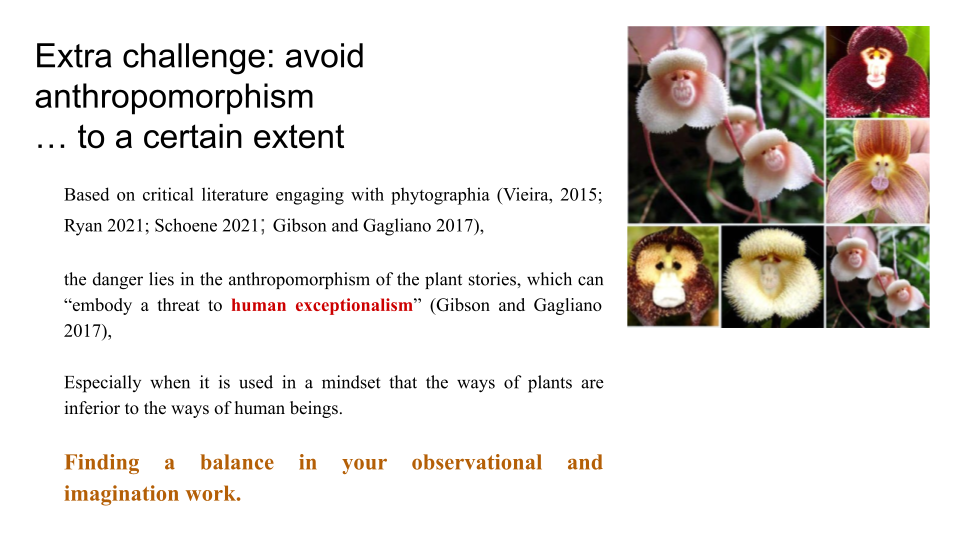
wHAT ABOUT ANTROPOMORPHISM?
Anthropomorphism is not bad. Editors, especially from more traditional publishers, have signalled to me, after they read my ecofiction projects, that to reach a mainstream audience or involve more themes that it is recommended to work with familiarity. Giving trees and plants some human features might make it easier for the participants to imagine how it is to be this plant.
However, anthropomorphism can enter in our creative writing and arts, because we think that humans are the most intelligent beings and because we perceive human intelligence as superior to vegetal or other intelligence. We try to avoid this human exceptionalism thinking in our practice.
How do we select the questions for the circle and the writing prompts?
Keep it simple and open. Set a theme, do some reading on the guest plant and the theme, and simple and open questions and prompts will appear.
I use almost always the same template, but I make time to redecorate and propose new writing prompts and questions for the circle
Mostly I try to keep the whole day free, to have a walk on my own and reflect on the theme, but also on the questions for the creative writing practice, and to redecorate the old slides, with photographs of the guest plant, and/or the theme.
Scheduling: try sessions at different hours
We have mostly guests from Europe and North-America (East Coast). Sometimes we do sessions in the afternoon (European time), but some people have other obligations and prefer the sessions that we organize in the later evening. On the other hand, some participants avoid screens in the evening and pass for the later scheduled sessions.
sTART WITH A WELCOME WORD AND A SONG – FOR A SOFT LANDING
Often I start the circle with a song. I know that people might arrive a bit later, so they do not miss a lot when they arrive in the middle of the song. I pick a song that fits the theme. It helps to land and also let them practice deep listening. In one of the next posts, I might make a playlist of all the songs that I selected.
MANAGING EXPECTATIONS, INCLUDING ATTENDANCE
We had a circle where nobody showed up. We had circles with 15-20 people. Is it because of the guest plant or the theme? Is it because of timing or not enough advertisement? Mostly because of lack of advertisement.
advertising: repetition is your assistant
The most succesfull action for me personally is to make the social media post and the zoom link (with pre-registration) 2-3 weeks beforehand, and to repost the social media post in stories, with a direct link and a clear call to action (CTA).

Do-it-with-others and let us know
We do this as voluntary work, but we do not judge if you create a more commercial practice. I can do this as voluntary work, because I am privileged and I have a well-paid parttime job. But I am very aware that not everyone is so lucky.
You can download the following slide decks that we used in previous sessions:
Let us know – in the COMMENTS to this blog- if you would like more materials.
Post advertisements, post instagram posts with impressions and musings and use the hashtag #writingwithplants.
dO YOU NEED MORE BACKGROUND?
Check out our project page on this website: Writing (with) plants – Project
Read an academic article that we wrote about Brussels Health Gardens, an older project at the roots of this practice:
Selliah, Sugirthini, Vitalija Povilaityte-Petri, and Wendy Wuyts. “Tensions and Invisible Costs in Co-Creating Nature-Based Health Knowledge in Brussels.” Urban Science 6.4 (2022): 68.https://www.mdpi.com/2413-8851/6/4/68
Discover more from Stories from the Wood Wide Web
Subscribe to get the latest posts sent to your email.
 Stories from the Wood Wide Web