A musing about the tensions between urban greening, cultural heritage and the role of the plants
Last summer, I went on a trip to the Balkan. I felt already eco-guilt and -shame about the flight and anxiety about the hot temperatures. I joined a friend who loves the Balkan; but can only take holidays in July. In the next weeks, I will share tree-inspired stories from the Balkan, because these trees were some of the beings that kept me sane in the scorching heat. This blog is about a visit to Dubrovnik in Croatia.

Being a tourist with fleeting experiences
I joined a Game of Thrones and history walking tour. The guide shared some plant histories. He pointed towards oleander trees that are venomous, shared sycamore immigration stories and showed the Franciscan monastery – one of the 3 oldest pharmacies- where they still make herbal tinctures. I learned that the meaning of Dubrovnik has to do with oak forests (that only exist in patches).
One of the profound moments was an encounter with a big sycamore tree, that we approached from a lower point.

Suffocating
However, I was suffocating, hopping from wall shadows to trees. Dubrovnik, the pearl of the Adriatic Sea – might suffocate like the rest of the ocean, I thought at some point. After lunch I heard one of the kitchen guys behind me say he wants to kill himself. I turned around and asked him if he was ok.
He said it was a joke.
Really?
He said it is too hot outside, and especially in the kitchen. The airco helps, but does not reduce the temperature significantly.
I notice that Dubrovnik is all about buildings. Sometimes I saw a plant, as decoration or on the walls.

I know there is often a conflict between cities’ heritage preservation and nature-based solutions such as green roofs or even placing rainwater catchment barrels or so, but then I wonder for whom we do this cultural heritage preservation?
For me, the tourist, this kitchen guy is frying himself, to prepare my meal and to live in a city where plants are not embraced as allies.
I had a long talk with my friend. I said it might be the last time that I travel to such warm place in summer. It does not make sense to be here and make it even warmer here in times of climate change. It was an uncomfortable conversation. She loves the Balkan, but she does not have the freedom to travel whenever she can. It was not only a dilemma between nature vs cultural heritage. It was also a dilemma which ethical values are more important: freedom of the individual vs responsibility for society. In Moral dilemmas there are no good or wrong answers.
For me, it is easier to ask… What are we willing to let go? For some people it is easier to let old ways of doing things go, but for others it is too much sacrifice of their freedom and expression of their identity. I am in a stage of life where I know I am changing the whole time because the world around me and in me is changing the whole time, and I accepted it and try to go with the flow. But I can understand that other people see themselves, the world and their reality differently, and to grasp the (environmental) ethic questions, the dilemmas and differences of prioritization of values.
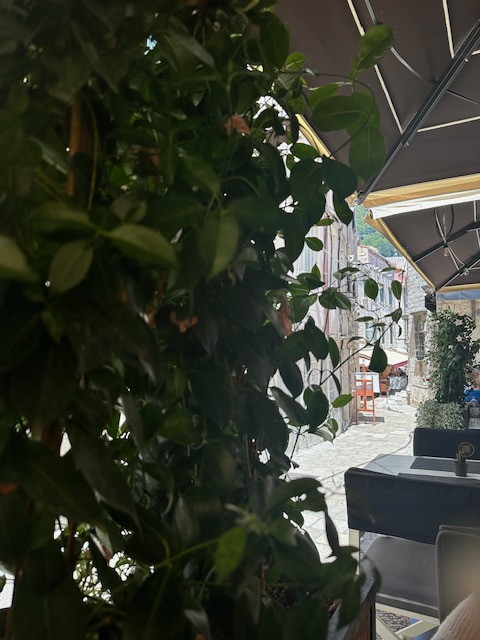
What are we willing to let go?
The past and future identity of Dubrovnik
There was also the Dubrovnik summer festival. In a brochure I read the visual identity creator’s text about the new and old Dubrovnik, his observation of plants who challenge what is new or old. This teaser made me enthusiastic, so I asked around if there is some walk or exhibition foregrounding the plants and their role of the past/present/future identity in Dubrovnik.
Different people said it is just a text about visual identity. There was no connection with context.
My travel companion remarked that I am «too cultural» for this place. Who wants to talk about city plants and their role in shaping an ancient city in times of climate change?
Artists for plants
Last summer I also discovered Artists for Plants, which is “a global call for Artists to improve our relationship with the plant world, with the understanding that we all inter-breath on this planet. (They) are an international artistic space dedicated to plants. Through (their) virtual spaces, social channels and our energy, (they) link together those who – conscious of the central role of plants for our survival – wish to collaborate.”
Their 2023 call: Rooting our cities
Their 2023 International Call is “focused on artworks dedicated to the plants living in our cities, sometimes planted by humans, sometimes spontaneously popping up in the most unexpected places as wonderful and unexpected guests, taking their right of citizenship. The call, named “Rooting our cities – focusing on the unexpected guests“, is developed in collaborations with the Botanical Garden of the University of Palermo (Sicily, Italy).”

Oleander
Shapeshifting into a sycamore tree
Last weekend was the deadline. I submitted a fiction story which can be seen as a reaction to my experience in Dubrovnik. I shapeshifted in the sycamore tree and told how the identity of the city is continuously challenged by immigrants and tourists. Not only humans, but also weeds and other plants. I read a blog about the relationship between the ivy and the sycamore in the Balkan, and I started writing…
On weeds
By coincidence, I got also a message from my friend V. . She and I talked before about the villainizing of weeds. Originally, the ivy had also a more villain role in the short story, but I realised that I am reinforcing certain ideas that places are static and never evolving.
Here is a passage from a recent academic paper by Virens that I like to share to let you think about :
“Weeds, unlike other plants, are often seen as more agential through their capacity to disrupt social processes, but this capacity is often to their detriment. While other plant agencies often become invisible through their role as resources, weeds are uncooperative and troublesome within current social structures. Weeds are often described in terms of their characteristics, through phrases such as ‘quick-growing vines’, ‘prolific seedbanks’, ‘dense thorns’ and ‘wide zones of seed dispersal’. But to focus on individual species of weeds is to ignore the role we also play in their success. As Robbins (2004, p. 140) states, ‘it is not species, but sociobiological networks that are invasive’.”
And I continued writing. I hope to share the short story with you in the following months.
References
Virens, A., 2023. Plants out of place: How appreciation of weeds unsettles nature in New Zealand. New Zealand Geographer, 79(2), pp.65-74.
Discover more from Stories from the Wood Wide Web
Subscribe to get the latest posts sent to your email.
 Stories from the Wood Wide Web